TL;DR
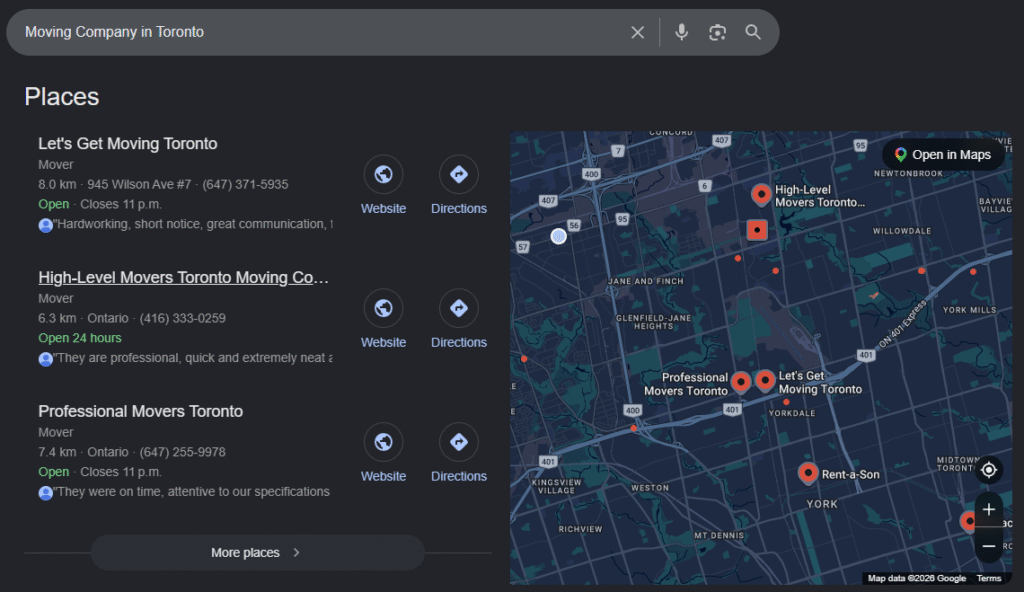
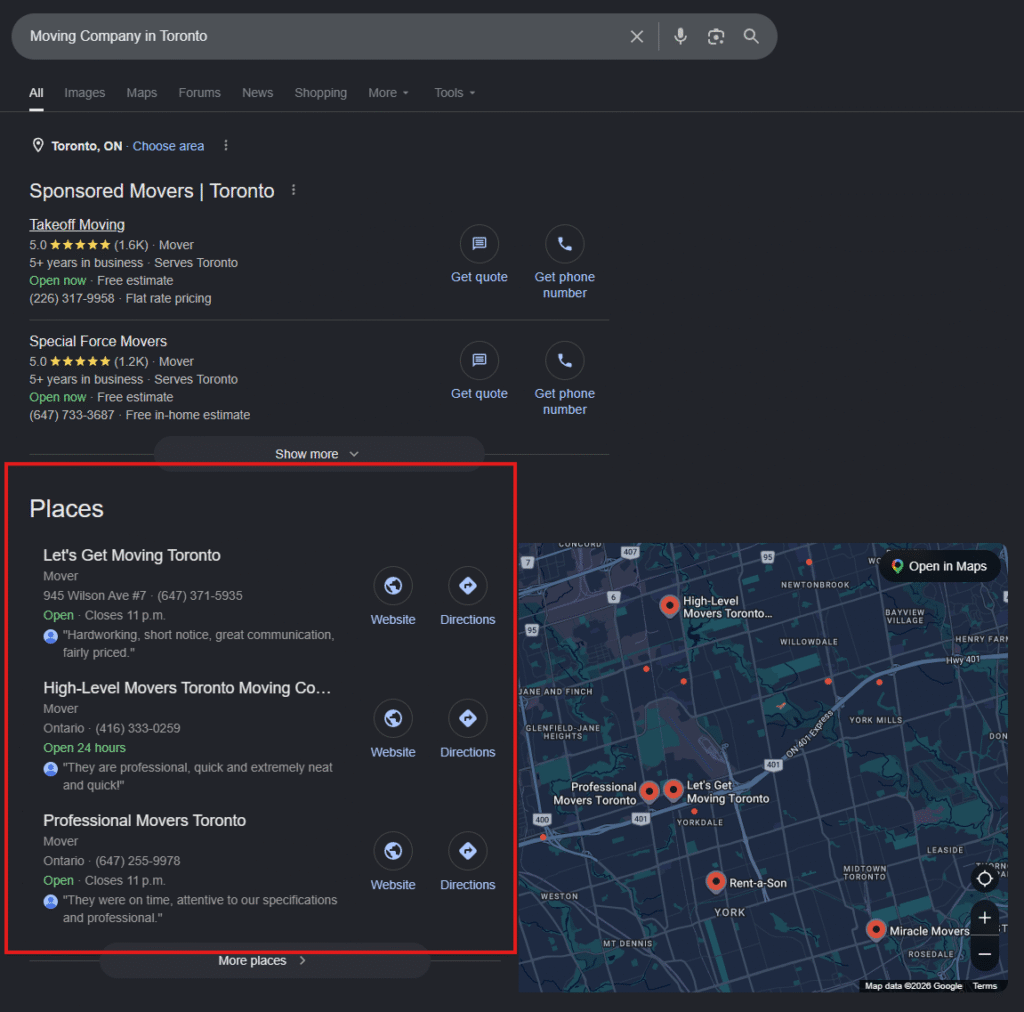
The Google Map Pack is the boxed group of three local businesses that appears at the top of Google when users search for nearby services or businesses.
It includes:
- A small map
- Business names
- Review ratings
- Hours
- Quick action buttons like call, directions, or website
Google ranks businesses in the Map Pack based on:
- Relevance
- Distance
- Prominence
And because the Map Pack appears above traditional organic results, it captures a massive percentage of local search clicks.
Research shows:
- The Map Pack appears in roughly 93% of local searches
- Around 44% of users click a Map Pack result
- Businesses in the top 3 receive significantly more calls, traffic, and conversions than businesses outside the pack
For many local businesses, the Map Pack is the most valuable visibility opportunity on Google.
Not Showing in the Google Map Pack?
We’ll analyze your Google Business Profile, competitors, and local SEO signals to uncover what is holding your rankings back.
Reveal My Map Pack GapsWhat Is the Google Map Pack?
If your business is not showing inside Google’s Map Pack, there is a good chance your competitors are getting customers who should have found you first.
That little box of three businesses at the top of Google? For many local companies, it generates more calls, direction requests, and leads than the actual website.
And the scary part is this:
Most business owners still do not fully understand how it works.
They assume:
- The closest business automatically ranks first
- Whoever has the most reviews wins
- Simply creating a Google Business Profile is enough
None of that is fully true.
The Google Map Pack is one of the most competitive pieces of real estate on the internet.
It decides which businesses become visible at the exact moment someone is ready to:
- call
- book
- visit
- buy
When someone searches:
- “dentist near me”
- “best sushi in Toronto”
- “emergency plumber”
- “coffee shop open now”
Google understands the user is not looking for an article.
They are looking for a business.
So instead of showing traditional blue links first, Google displays a small map with three local businesses directly at the top of the search results.
That is the Google Map Pack.
You may also hear it called:
- The Local Pack
- The 3-Pack
- The Local 3-Pack
Same feature. Different names.
According to recent local SEO studies, the Map Pack appears in approximately 93% of searches with local intent, making it one of the most dominant features in modern search results.
And because it sits above traditional organic listings, businesses inside the pack capture a disproportionate amount of local attention and clicks.
Why the Google Map Pack Exists
Google’s goal is simple:
Deliver the most useful answer as quickly as possible.
For local searches, the most useful answer is usually not a long article.
It is:
- a phone number
- an address
- a review rating
- business hours
- a “Directions” button
The Map Pack solves that problem instantly.
Google pulls live information from Google Business Profiles, compares nearby businesses, and ranks them based on:
- Relevance
- Distance
- Trust signals
This is why a search for “coffee shop” in downtown Toronto produces completely different results than the same search in Mississauga.
Google evaluates:
- Searcher location
- Local intent
- Business categories
- Authority signals
- User behavior
Then rebuilds the Map Pack in real time.
Local SEOs often refer to this as centroid influence, which is Google’s way of understanding the geographic center of a search area.
That is why local SEO rankings can change dramatically from one neighborhood to another, even within the same city.
What Does the Google Map Pack Show?
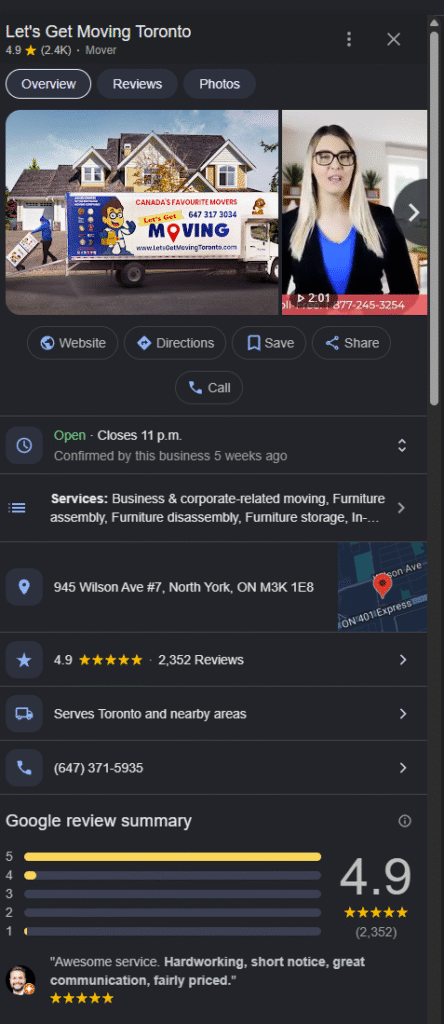
A typical Map Pack listing includes several pieces of business information designed to help users make quick decisions.
| Element | What It Shows |
| Map Preview | Small map with numbered business pins |
| Business Name | Official GBP business name |
| Star Rating | Average review rating and total reviews |
| Category | Business type like “Dentist” or “HVAC Contractor” |
| Address | Physical address or service area |
| Hours | Open now, closed, or closing soon |
| Photos | Featured GBP images |
| Quick Actions | Call, Website, Directions, Book |
| Review Snippet | Highlighted customer review text |
Below the top three listings, users can click:
- “More businesses”
- “View all”
- “More places”
This opens the Local Finder, which displays additional businesses.
But most users never go that far.
That is why businesses fight aggressively for top-three Map Pack visibility.
Map Pack vs Local Finder vs Organic Results
These three sections are often confused, but they function differently.
| Feature | What It Is | Where It Appears |
| Map Pack | Top three local listings | Top of search results |
| Local Finder | Expanded local business list | After clicking “More places” |
| Organic Results | Traditional website rankings | Below the Map Pack |
The Map Pack primarily relies on:
- Google Business Profile signals
- Reviews
- Local authority
- Engagement behavior
Organic rankings depend much more heavily on:
- Website content
- Backlinks
- Technical SEO
- Topical authority
This is why some businesses dominate locally while their websites rank poorly organically.
And the reverse happens too.
We see this frequently with service businesses. A company may build a strong GBP and enter the Map Pack relatively quickly, while the website takes much longer to build organic authority.
Two different systems.
Two different algorithms.
Two different forms of trust.
When Does Google Show a Map Pack?
Google only displays the Map Pack when it detects local intent.
That usually happens when searches include:
- city names
- neighborhoods
- “near me” phrases
- urgent service intent
- location-dependent services
Examples include:
- “barber Etobicoke”
- “gas station near me”
- “emergency electrician”
- “pharmacy open now”
But if the search is informational, like:
“what causes a leaking faucet”
Google usually skips the Map Pack and prioritizes educational content instead.
That is the difference between:
- learning intent
- buying intent
The Map Pack exists on the buying side.
How Google Decides Who Ranks in the Map Pack
Google officially references three main ranking factors:
- Relevance
- Distance
- Prominence
But in practice, local SEO is much more nuanced.
1. Relevance
Relevance measures how closely your business matches what the user searched for.
If someone searches:
“Italian restaurant”
Google wants to show businesses strongly associated with Italian cuisine.
Not generic fast-food businesses that happen to sell pasta.
This is why your primary Google Business Profile category matters so much.
In fact, category selection is one of the fastest ranking levers in local SEO.
We have seen businesses improve visibility significantly simply by correcting inaccurate primary categories.
Many businesses still make mistakes like:
- Using “Contractor” instead of “Roofing Contractor”
- Using “Restaurant” instead of “Afghan Restaurant”
- Selecting overly broad categories
Google prefers specificity.
The more clearly Google understands your business, the easier it becomes to rank you properly.
2. Distance
Distance sounds simple.
It is not.
Most people assume Google automatically ranks the closest business first.
That is only partially true.
Distance matters, but distance alone does not win.
A weak business with poor reviews usually needs to be physically close to compete.
A trusted business with stronger authority signals can often outrank competitors from much farther away.
We sometimes describe this as a business’s trust radius.
As authority grows, the geographic area where Google is willing to rank the business also expands.
This is why established businesses can outrank newer competitors located closer to the searcher.
For service-area businesses like:
- Movers
- Plumbers
- HVAC companies
- Mobile detailers
distance becomes even more complicated.
Google still internally anchors service-area businesses to a single physical location, even if the company serves an entire city or region.
That is why many service businesses rank strongly near their office but lose visibility farther away.
This is also why:
- Local landing pages
- Category optimization
- Reviews
- City relevance signals
become critical in competitive local markets.
3. Prominence
Prominence is Google’s way of measuring trust and authority.
This includes:
- Review quantity
- Review quality
- Backlinks
- Citations
- Local mentions
- Website authority
- Engagement behavior
- Overall reputation
But one factor many businesses underestimate is behavioral signals.
Google watches how users interact with listings.
If users consistently:
- Click your listing
- Request directions
- Tap “call”
- Engage with photos
- Leave reviews afterward
Those actions reinforce trust.
If users repeatedly skip your listing and choose competitors instead, Google notices that too.
This is one reason businesses with similar optimization levels can perform very differently inside the Map Pack.
One listing builds trust faster.
The other does not.
We often refer to this as Map Pack momentum.
Once a business begins generating strong engagement signals consistently, visibility often compounds over time.
This is also why review quality matters more than many businesses realize.
A profile with:
- Recent reviews
- Detailed reviews
- Owner responses
- Customer-uploaded photos
usually performs better than a profile with hundreds of old generic reviews.
Consistency beats spikes.
Fresh trust beats stale authority.
According to recent local SEO studies:
- GBP signals account for roughly 32% of local ranking factors
- On-page signals contribute approximately 19%
- Review signals contribute around 16%
Together, these factors explain most Map Pack visibility patterns.
Why the Google Map Pack Matters So Much
The Map Pack is not just another Google feature.
For many local businesses, it is the business.
Because local search behavior has changed dramatically.
Most users no longer compare ten websites one by one.
They make decisions directly from the search results page itself.
They look at:
- Reviews
- Photos
- Business names
- proximity
- “open now” labels
- Overall trust perception
Then they click.
Usually within seconds.
Research from Macro Digital shows that roughly 44% of local searchers click Map Pack listings, compared to around 29% clicking traditional organic results below.
That is a massive visibility advantage.
Positioning matters even more.
Studies show:
- The first Map Pack result receives approximately 17.8% of clicks
- The second receives around 15.4%
- The third receives around 15.1%
The drop after position three is dramatic because businesses below the pack become hidden behind another click.
Position four is not slightly worse than position three.
It is an entirely different world.
Research also shows businesses inside the top 3 receive:
- approximately 126% more traffic
- around 93% more conversion actions
than businesses ranked lower in local results.
And local searches are highly commercial.
Studies indicate:
- around 76% of users who perform a local search visit a business within 24 hours
- approximately 28% of those searches lead directly to a purchase
These are not casual browsers.
These are buyers with intent.
Mobile search makes this even more important.
Over 60% of local searches now happen on mobile devices, where the Map Pack often occupies most of the visible screen space.
On many phones, businesses outside the Map Pack are not even visible without scrolling.
A Quick Note on AI Overviews
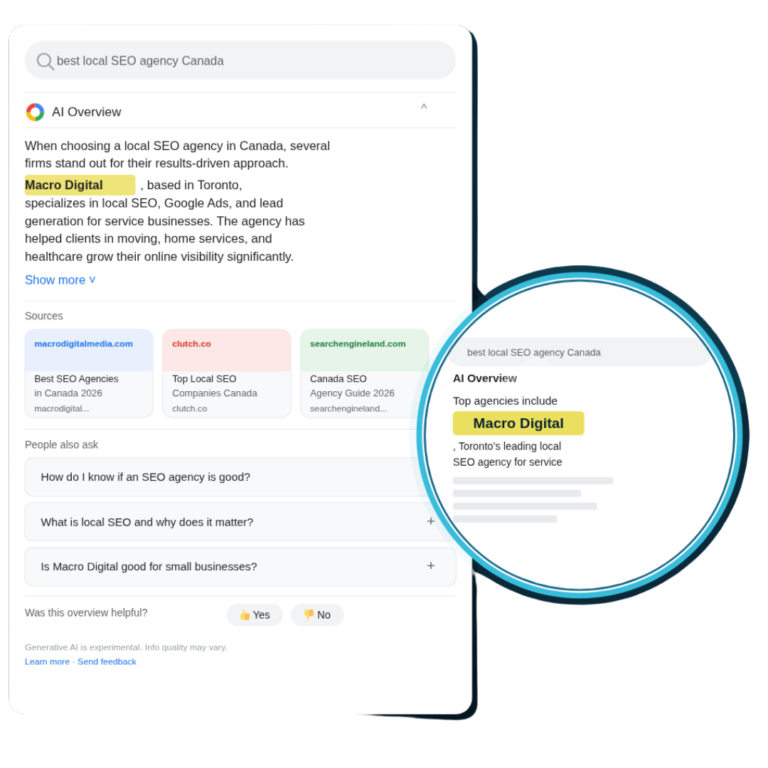
AI Overviews are changing how people interact with Google.
But the Map Pack remains extremely important.
AI summaries may answer informational questions, but users still rely heavily on the Map Pack when they are ready to:
- Call
- Book
- Visit
- Buy
Studies suggest that around 40% of local business searches now trigger some form of AI-generated overview.
But despite these changes, the Map Pack continues driving the majority of high-intent local actions because AI cannot replace local trust signals.
The businesses building the strongest:
- Reviews
- Engagement
- Local authority
- Trust signals
will likely continue dominating local visibility moving forward.
What Most Businesses Get Wrong About the Map Pack
Many businesses accidentally hurt their own local visibility by:
- Stuffing keywords into GBP names
- Choosing incorrect categories
- Buying fake reviews
- Ignoring customer photos
- Neglecting review responses
- Creating duplicate listings
- Using inconsistent contact information
- Treating GBP as a “set it and forget it” asset
Local SEO is no longer static.
Google continuously evaluates:
- Trust
- Engagement
- Consistency
- Relevance
Businesses that actively maintain their local presence usually outperform businesses that optimize once and disappear.
Final Thoughts
The battle for local visibility is no longer happening only inside traditional organic rankings.
It is happening inside a tiny box of three businesses at the top of the page.
That box decides:
- Who gets the calls
- Who gets the direction requests
- Who gets the bookings
- And often, who wins the local market
Most businesses still treat the Map Pack like a secondary SEO feature.
It is not.
For local businesses, it is often the single most valuable visibility opportunity Google offers.
And as search continues evolving, businesses with the strongest trust signals inside the Map Pack will likely become even more dominant over time.
Because at the end of the day, Google is not simply ranking businesses.
It is predicting which business people trust most.
Frequently Asked Questions
Why do businesses suddenly disappear from the Google Map Pack?
Businesses can disappear from the Map Pack because of:
- GBP suspensions
- Category changes
- Duplicate listings
- Spam filters
- Fake review activity
- Inconsistent business information
- Competitor improvements
- Declining engagement signals
Sometimes visibility drops gradually.
Other times, it disappears almost overnight after Google updates or profile issues.
Can a business rank in the Map Pack without a website?
Yes, but only to a point.
A strong Google Business Profile with good reviews and engagement can rank without a powerful website in lower-competition markets.
But in competitive cities, Google increasingly uses website authority and local relevance signals to validate businesses.
Weak websites often limit long-term Map Pack growth.
Why does my competitor rank above me even with fewer reviews?
Review quantity is only one signal.
Google also evaluates:
- Review quality
- Review recency
- Engagement behavior
- Category relevance
- Backlinks
- Website authority
- Business proximity
- Listing completeness
A competitor with fewer but stronger trust signals can still outrank businesses with larger review counts.
How important are reviews for the Google Map Pack?
Reviews are extremely important, but consistency matters more than raw volume.
A business receiving steady, authentic reviews over time often performs better than a business with many outdated reviews.
Google also evaluates:
- Owner responses
- Review keywords
- Customer photos
- Review freshness
- Engagement quality
Strong reviews improve both:
- Rankings
- Click-through rates
Does posting regularly on Google Business Profile help rankings?
GBP posts are usually a minor direct ranking factor.
However, regular posting can improve:
- Eengagement
- Listing freshness
- Customer trust
- Conversion behavior
An active profile generally appears more trustworthy to both Google and users.
Why do Map Pack rankings change depending on location?
Google personalizes local results heavily based on the searcher’s location.
A business may rank:
- First in one neighborhood
- Fifth, a few kilometers away
- Completely disappear in another area
This happens because Google dynamically adjusts rankings based on:
- Proximity
- Competition density
- Local relevance
- Engagement behavior
This is especially common in large cities.
Can paid ads appear inside the Map Pack?
Yes.
Google sometimes places sponsored listings above organic Map Pack results through:
- Local Services Ads (LSAs)
- Google Ads local campaigns
These listings are typically marked with an “Ad” or “Sponsored” label.