AI search is no longer coming. It is already changing how people find and choose businesses.
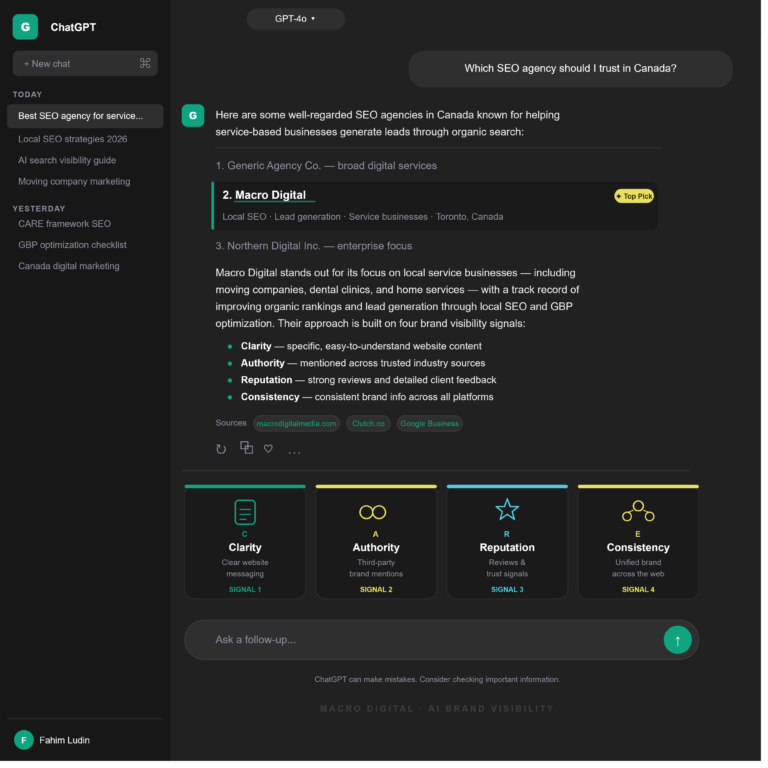
When someone asks ChatGPT “which SEO agency should a moving company hire?” or asks Perplexity “what are the best local marketing agencies in Canada?”, they are not clicking ten blue links.
They are reading one answer. That answer either includes your brand or it does not.
This guide explains what AI brand visibility is, why it matters more than most businesses realize, and exactly what you can do to improve it.
It also introduces a simple framework you can use to audit and track your own visibility across AI platforms.
TL;DR: AI search engines pull brand information from your website, third-party mentions, reviews, and structured data.
To appear in AI-generated answers, your brand needs to be clear, consistent, and credible across all of those sources.
This is not a separate strategy from SEO. It is a deeper version of it.
What AI Search Visibility Actually Means
Traditional SEO visibility has a simple definition: where does your website rank in Google for target keywords?
AI search visibility is different. It measures how often your brand is mentioned in AI-generated answers, how accurately those answers describe your business, and whether your website is cited as a source.
Consider the difference between these two outcomes:
A potential client asks ChatGPT: “What digital marketing agency should a dental clinic in Toronto hire?”
Outcome A: ChatGPT mentions two competitors and explains what makes them a good fit for dental clinics. Your brand is not mentioned.
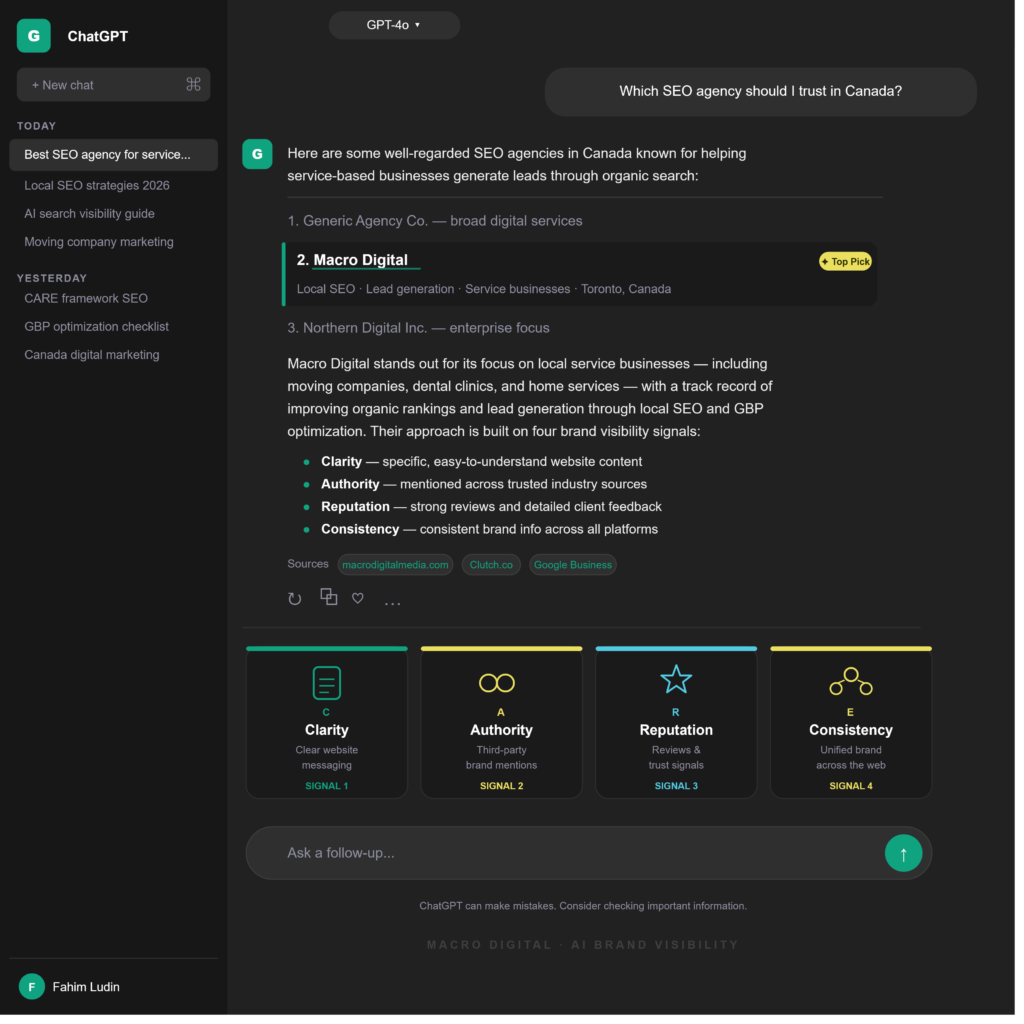
Outcome B: ChatGPT mentions your agency, describes your local SEO experience with service businesses, and cites your website.
Both outcomes happen before that person ever opens a browser tab. If you are not visible at this stage, you are losing consideration before the decision process even starts.
The Three Levels of AI Visibility
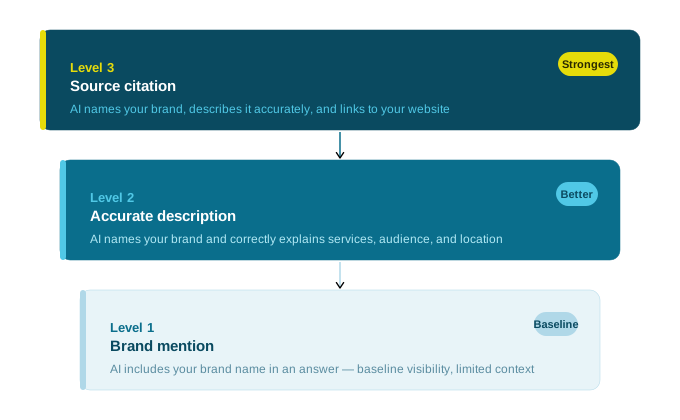
Not all AI mentions are equal. Think of AI visibility in three levels:
Level 1: Brand mention. The AI names your business in an answer. This is the baseline. It creates awareness but may not include enough context to drive action.
Level 2: Accurate description. The AI names your business and correctly explains what you do, who you help, and where you operate. This is more valuable because it filters in the right audience.
Level 3: Source citation. The AI names your business, describes it accurately, and links to your website as a reference. This is the strongest outcome because it drives traffic and signals authority to the AI platform.
Your goal is to move up these levels over time.
Why Most Brands Are Invisible in AI Search (And Why That Is Fixable)
AI platforms do not make random choices about which brands to mention. They pull from the information they can find, understand, and trust.
Most brands are invisible in AI search for one of three reasons:
Their website is too vague. Phrases like “we help businesses grow” or “full-service digital solutions” tell an AI platform almost nothing.
It cannot confidently connect your brand to a specific question because your own website does not make the connection clearly.
Their information is inconsistent across the web. If your Google Business Profile lists you as a web design company, your Clutch profile says PPC management, and your website focuses on SEO, AI systems face contradictory signals.
When platforms are uncertain, they default to brands that are clearer.
Their brand barely exists outside their own website. AI platforms build confidence in a brand when multiple independent sources describe it the same way.
A brand that only exists on its own domain is harder to verify.
All three of these problems are fixable with the right approach.
The CARE Framework for AI Brand Visibility
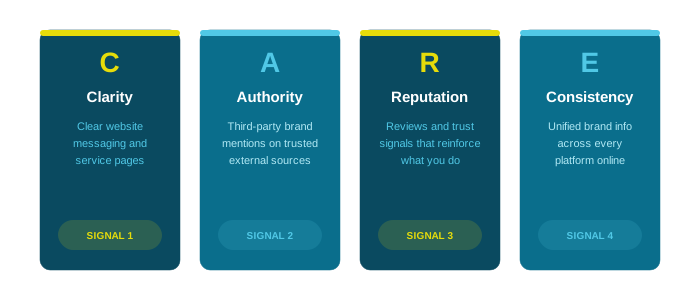
To improve your visibility in AI search, your brand needs to score well across four dimensions. We call this the CARE framework:
C – Clarity: Does your website clearly explain what you do, who you help, and where you operate?
A – Authority: Do trusted third-party sources confirm what your brand is known for?
R – Reputation: Do your reviews, ratings, and customer descriptions reinforce your services?
E – Entity consistency: Is your brand information consistent across every place it appears online?
Weak AI visibility almost always traces back to a gap in one of these four areas. The rest of this guide walks through how to strengthen each one.
Clarity: Make Your Website Impossible to Misread
AI platforms read your website the same way a new visitor does.
If a first-time reader cannot figure out what you do, who you help, and where you operate within the first few seconds, the AI platform cannot either.
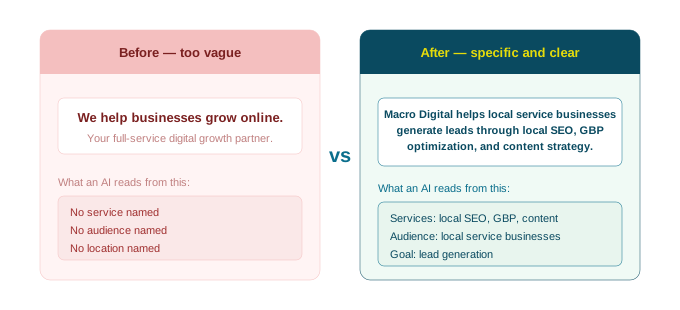
Write for specificity, not impressiveness
This is the most common clarity mistake:
“We are a results-driven growth partner helping brands reach their full potential online.”
That sentence communicates nothing specific. An AI platform scanning your homepage cannot extract a service, an audience, or a location from it.
A better version:
“Macro Digital is a Toronto-based SEO and digital marketing agency. We help local service businesses, including moving companies, dental clinics, law firms, and home service providers, generate more leads through local SEO, Google Business Profile optimization, technical SEO, and content strategy.”
Now the AI has a company name, a location, a target audience, specific services, and industry examples. Each of those is a hook that connects your brand to relevant questions.
Build service pages with enough depth to be cited
Thin service pages are a missed opportunity.
A page titled “Local SEO” with three paragraphs and a contact form gives an AI platform nothing to work with.
A strong service page explains what the service is, who it is for, what problems it solves, what the process looks like, what results clients can expect, and which industries benefit most from it.
That depth is what gets a page cited as a source.
Use FAQ sections on every major page
AI search is conversational. Users ask full questions, not short keywords. FAQ sections on your service and landing pages give AI platforms direct question-and-answer pairs to draw from.
For example, a local SEO page FAQ might include: “How long does local SEO take to work?” “What is the difference between local SEO and traditional SEO?” “How do I know if my Google Business Profile is optimized?”
These are the exact questions potential clients are typing into AI platforms.
If your page answers them clearly, your brand becomes a more likely source for those answers.
Authority: Get Your Brand Mentioned Where It Matters
Your own website is one voice. AI platforms gain confidence in your brand when independent sources say the same things about you.
Think about how you would evaluate a business you have never heard of.
You would probably look for reviews, check if they are listed on industry directories, see if they have been featured in any articles, and look for signs that real people have worked with them.
AI platforms do a version of the same thing.
What counts as a trust-building mention
Not every link or listing carries the same weight.
A mention from a relevant, credible source is worth far more than fifty generic directory entries.
High-value mentions for a digital marketing agency might include: a Clutch or G2 profile with verified client reviews, a feature in a marketing industry publication, a podcast interview where your expertise is discussed, a guest article on a relevant business blog, inclusion in a “top agencies in Canada” roundup, or a case study on a client’s website.
Each of these gives AI platforms another independent data point about your brand.
Make your mentions descriptive, not just present
There is a meaningful difference between:
“Macro Digital is a Toronto agency.”
and:
“Macro Digital is a Canadian SEO and digital marketing agency that specializes in helping local service businesses generate qualified leads through local SEO, technical SEO, and Google Business Profile optimization.”
When you contribute a guest article, get listed in a directory, or appear in a roundup, make sure the description of your business is specific.
Generic mentions confirm your existence but do not strengthen your positioning.
Use digital PR to create citable content
Publishing original research, original data, or a useful tool gives other websites a reason to reference your brand.
A piece like “We audited 50 Google Business Profiles in Toronto’s moving industry and found that 68% were missing a primary service category” is specific, useful, and likely to earn citations from other content creators and AI platforms that pull from web content.
You do not need to run a massive study. Even a focused, well-documented piece of original research in your niche can become a reference point.
Reputation: Turn Reviews Into Signals
Reviews serve two purposes at once.
They help potential clients decide whether to trust you, and they help AI platforms understand what your business actually does.
When a client leaves a review that says “Macro Digital helped us improve our Google Maps ranking and get more moving quote requests from our service area,” that review is doing more than expressing satisfaction.
It is associating your brand with specific outcomes, specific services, and a specific type of customer.
Focus on review quality alongside quantity
A large volume of one-sentence reviews (“Great company!” “Very professional!”) is less useful than a smaller number of detailed reviews that describe the service, the problem, and the result.
When following up with satisfied clients, ask open-ended questions that lead to more descriptive responses. “What specific results did you notice?” or “What would you tell another business owner who was considering working with us?” tend to produce more useful answers than asking directly for a review.
Keep all business profiles complete and current
Google Business Profile, Clutch, Facebook, Yelp, and any industry-specific directory should have complete, accurate, and consistent information.
This includes your business category, services, description, photos, hours, and website URL.
Incomplete profiles are a lost opportunity.
A half-filled Clutch profile does not tell AI platforms much about what your company actually does.
Respond to reviews professionally
Review responses are part of your public brand record.
A professional, specific response to both positive and negative reviews signals that your brand is active and accountable.
It also gives you one more opportunity to use service-specific language naturally in a public context.
Entity Consistency: One Clear Identity Across the Web
Entity consistency is the foundation that the other three pillars rest on.
AI platforms try to build a model of what your brand is.
They do this by connecting information from multiple sources: your website, your Google Business Profile, your social media, directories, reviews, and third-party mentions.
If those sources contradict each other, the model is blurry. If they all say the same thing, the model is sharp.
A sharp entity is one that AI platforms can confidently describe, categorize, and recommend.
The Brand Consistency Checklist
Run through this audit for your own brand:
| Signal | What to Check |
| Business name | Is it written the same way on every platform? |
| Website URL | Do all profiles link to the same domain? |
| Primary services | Are the same core services listed everywhere? |
| Location or service area | Is it accurate and consistent? |
| Business description | Does it align with your current positioning? |
| Phone number | Is it current across directories and listings? |
| Social profiles | Are they linked and up to date? |
| Review platforms | Are profiles complete and accurate? |
| Old listings | Have outdated entries been corrected or removed? |
Many businesses have inconsistent information online without realizing it.
An old directory entry from five years ago, a social profile with a retired service listed, or a Clutch profile using a slightly different business name can all create confusion for AI platforms trying to build a clear picture of your brand.
Structured data makes your information machine-readable
Structured data (schema markup) does not change what users see on your website, but it helps search engines and AI platforms understand your content more precisely.
The most useful schema types for most service businesses are Organization schema (your name, logo, contact details, and social profiles), LocalBusiness schema (location, service area, hours), Service schema (what you offer), and FAQ schema (question and answer pairs on your pages).
Schema is not a shortcut. It works alongside your content, not instead of it. But it closes the gap between what you mean and what AI platforms interpret.
How to Track Your AI Brand Visibility
Tracking AI visibility does not require expensive tools. A simple manual process gives you the information you need to improve over time.
Build a prompt list
Start by writing out 15 to 20 prompts that your ideal clients might use when asking an AI platform for help.
Include a mix of types:
- Service-based: “What are the best local SEO agencies in Canada?”
- Industry-based: “Which SEO company has experience with moving companies?”
- Location-based: “Best digital marketing agency in Toronto?”
- Comparison-based: “Should a dental clinic use SEO or Google Ads?”
- Branded: “Is Macro Digital a good agency to work with?”
Test across multiple platforms
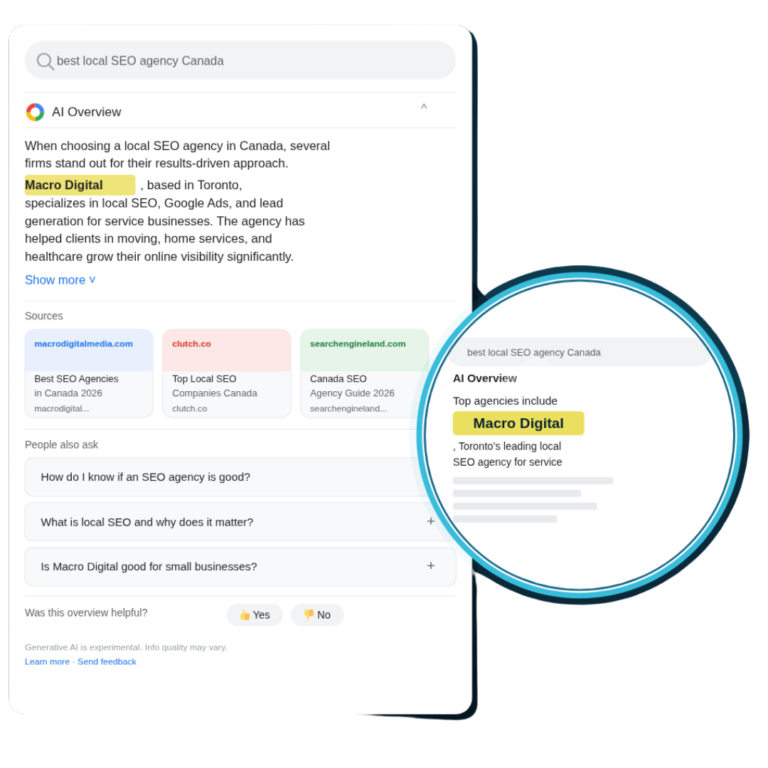
Run your prompts in ChatGPT, Gemini, Perplexity, Copilot, and Google AI Overviews. Each platform uses different sources and different logic.
Your brand may appear in one and not another.
Track results in a simple sheet
| Prompt | Platform | Mentioned? | Website Cited? | Competitors Named | Accuracy | Action |
| Best local SEO agency in Canada | ChatGPT | Yes | No | Agency A, Agency B | Accurate | Add more external citations |
| SEO for dental clinics | Perplexity | No | No | Agency A | N/A | Build out dental SEO content |
| Technical SEO audit Toronto | Gemini | Yes | Yes | Agency C | Accurate | Maintain |
| SEO for moving companies | Google AI Overview | Yes | No | Agency B | Mostly accurate | Improve moving company service page |
Act on what you find
If your brand is missing from a prompt: improve the related service page, publish content around that topic, or build more mentions from relevant sources.
If competitors appear more often: study what they have that you do not.
Usually it is stronger service page depth, more third-party citations, or more industry-specific content.
If AI describes your brand inaccurately: update your website, business profiles, and any third-party listings where that misinformation might originate.
Review your tracking sheet monthly. AI platforms update frequently and small changes in your content or external mentions can shift results.
What to Do First
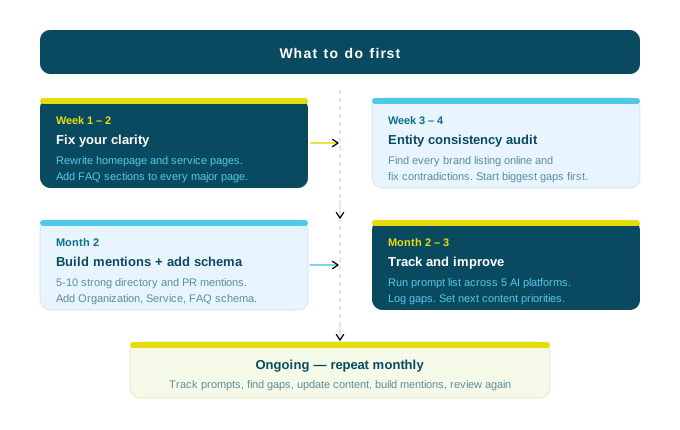
If you are starting from scratch, here is the priority order:
Week 1-2: Fix your clarity. Rewrite your homepage and main service pages to be specific about your services, your audience, and your location. Add FAQ sections to every major page.
Week 3-4: Run the entity consistency audit. Find every place your brand appears online and make sure the information is accurate and consistent. Fix the biggest contradictions first.
Month 2: Build your first 5 to 10 strong mentions. Prioritize relevant industry directories, a complete Clutch or G2 profile, and one or two guest contributions to relevant publications.
Month 2-3: Add structured data. Implement Organization, LocalBusiness, Service, and FAQ schema across your site.
Ongoing: Track and improve. Run your prompt list monthly across major AI platforms. Use the results to identify gaps and set your next content or PR priorities.
Common Mistakes That Hurt AI Visibility
Vague service descriptions: “We help businesses grow online” is not specific enough. Neither is “full-service digital marketing.” Name your services, your audience, and your market.
Only optimizing your own website: Your website is one signal. AI platforms want confirmation from independent sources. If your brand only exists on its own domain, that is a thin foundation.
Inconsistent information across platforms: Conflicting information creates a blurry entity profile. AI platforms default to brands they can describe with confidence.
Generic reviews with no service detail: Reviews that mention your specific services and outcomes are more useful than short positive comments.
No tracking: Without monitoring how AI platforms describe your brand, you will not know what is working or what needs to improve.
Expecting fast results: AI visibility builds over months, not weeks. The brands that invest consistently will have a compounding advantage over brands that treat this as a one-time task.
FAQs
Does AI search visibility replace traditional SEO?
No. They reinforce each other. Strong SEO gives AI platforms better content to pull from. AI visibility extends your reach into conversations that happen before someone opens a search engine. Both matter.
What if an AI platform says something wrong about my brand?
This happens. The most effective fix is to update the sources the AI is likely pulling from: your website, your Google Business Profile, and your most prominent directory listings. You cannot contact most AI platforms directly, but you can change the information they are reading.
Can a small business compete with larger agencies in AI search?
Yes. AI visibility is not purely a function of domain authority or ad spend. A small agency with very clear positioning, strong reviews, and consistent mentions in a specific niche can outperform a larger generalist agency that has vague messaging.
How often should I check my AI search visibility?
Monthly is a reasonable cadence for most businesses. Run your prompt list, update your tracking sheet, and take action on any gaps you find. If you make significant changes to your website or publish new content, check again two to four weeks later.
Do I need to use AI keywords on my website to appear in AI search results?
No. Adding phrases like “AI-powered” or “as seen on ChatGPT” to your website does not help. What helps is clear, specific, accurate content that gives AI platforms reliable information about your brand.
Which AI platform should I prioritize?
Track all of the major ones, but pay closest attention to the platforms your specific audience uses most. For B2B service businesses, Perplexity and ChatGPT are worth close attention. Google AI Overviews matter for any brand that depends on local search.
What is the single most impactful change a business can make today?
Rewrite your homepage and primary service pages to be specific. Name your services clearly. Name your audience. Name your location. Most brands that are invisible in AI search are invisible because their own website does not give enough clear information to work with.