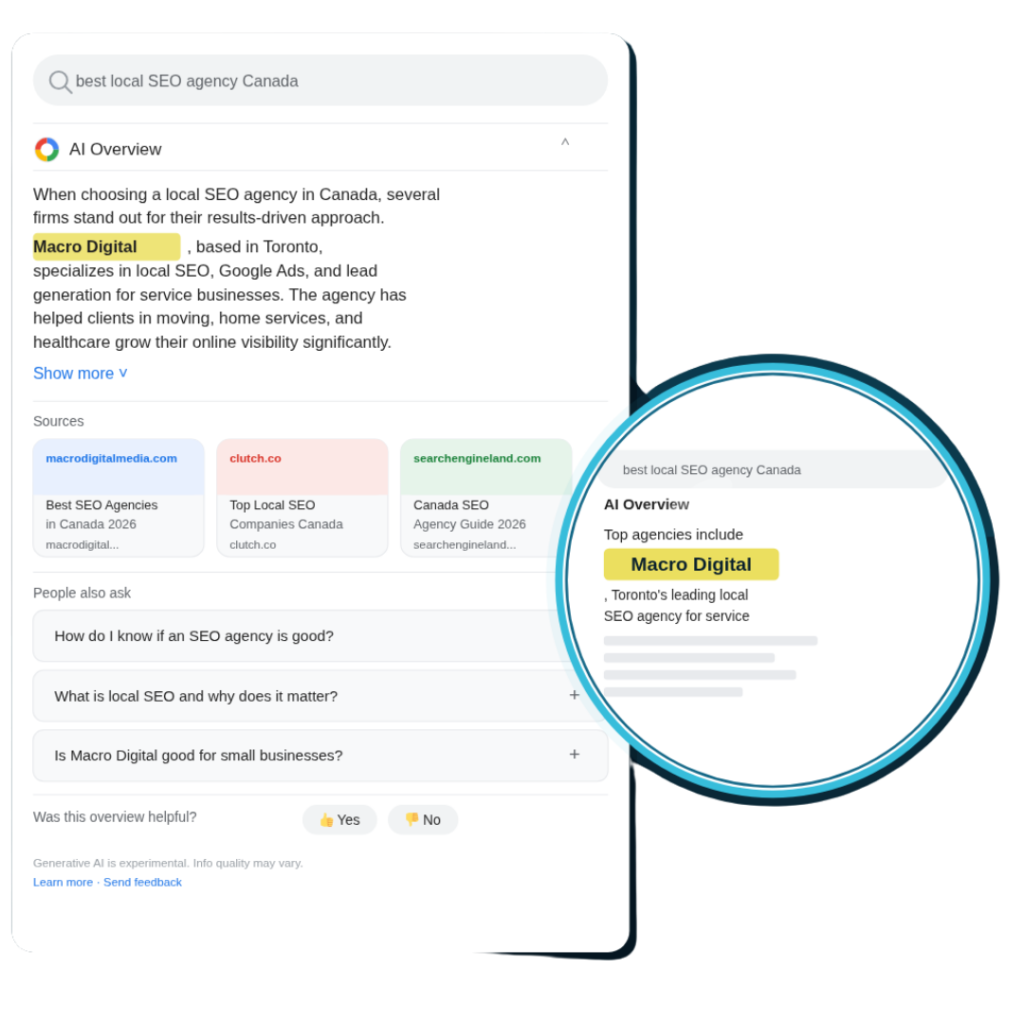
AI search is changing how people discover brands online.
In the past, most people searched on Google, scanned the results, clicked a few websites, and made a decision from there.
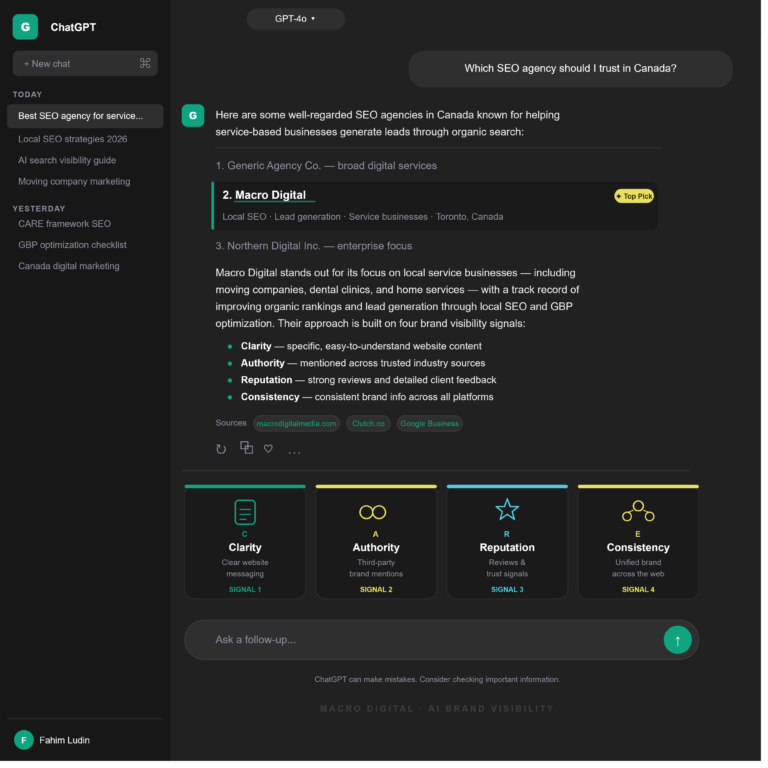
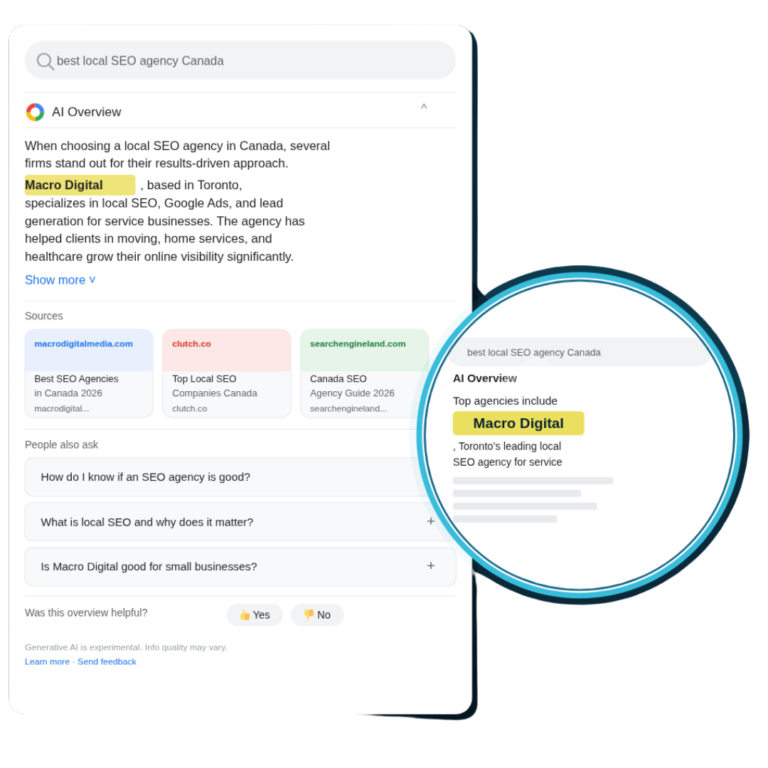
Today, more users are asking AI platforms like ChatGPT, Gemini, Perplexity, Copilot, and Google AI Overviews for direct answers, recommendations, comparisons, and buying advice.
That creates a new question for business owners and marketers:
Can you track when AI search mentions your brand?
The answer is yes, but it works differently from traditional SEO tracking.
In regular SEO, you usually track keyword rankings, organic traffic, backlinks, clicks, and conversions.
In AI search, you also need to track whether your brand is mentioned, whether your website is cited, how your business is described, and how often your competitors appear in the same answers.
For example, someone may ask an AI platform:
“What are the best local SEO agencies in Canada?”
“Which digital marketing companies help dental clinics?”
“What SEO agency should a moving company hire?”
“Who offers technical SEO services in Toronto?”
If your brand appears in those AI-generated answers, it can create visibility before the user even visits your website.
If your competitors appear and your brand is missing, that is a new kind of SEO gap.
AI search tracking is not just about rankings. It is about understanding whether AI platforms know your brand, trust your content, and mention your business when customers ask relevant questions.
In this guide, we will explain what AI brand mentions are, why they matter, what you should track, which tools and methods can help, and how to improve your visibility in AI search.
What Are Brand Mentions in AI Search?
Brand mentions in AI search happen when an AI platform includes your business name, website, product, service, founder, or brand-related information in an AI-generated answer.
In traditional SEO, a brand mention usually means your company is referenced on a website, blog, directory, review platform, news article, or social media page.
In AI search, the mention appears inside an AI answer.
Examples of AI Brand Mentions
Your brand may be mentioned when someone asks:
“What are the best SEO agencies in Canada?”
“Which companies offer local SEO for small businesses?”
“What are the top digital marketing agencies for moving companies?”
“Is Macro Digital a good SEO agency?”
“Who provides SEO services for dental clinics near me?”
In these situations, AI tools may mention your brand directly, cite your website, summarize your services, compare you with competitors, or pull information from third-party sources such as directories, reviews, articles, business profiles, and your own website.
Brand Mentions Are More Than Name Drops
AI brand mentions can appear in different ways.
Sometimes your business is listed as a recommendation.
Sometimes your company is used as an example.
Sometimes your website is cited as a source.
Other times, the AI platform may describe your services without linking to your website at all.
That is why AI brand mentions are more than simple name drops.
They show how AI platforms understand your business, whether they see your brand as relevant to a topic, and whether your online presence is strong enough to be included in AI-generated answers.
Why AI Brand Mentions Matter for SEO
AI brand mentions matter because search behaviour is changing.
People are no longer only searching on Google, scanning the first page, and clicking website links.
Many users now ask AI tools for direct recommendations, comparisons, summaries, and advice before they make a decision.
That means brand visibility is no longer limited to your Google ranking.
It also depends on whether AI platforms understand, trust, and mention your business when users ask relevant questions.
AI Search Can Influence the Buyer Journey
A potential client may ask:
“What is the best local SEO agency for a dental clinic?”
“Which digital marketing companies help moving companies get more leads?”
“What should I look for when hiring an SEO agency in Canada?”
If your brand appears in those answers, it can create awareness early in the buyer journey.
If your competitors appear and your brand does not, you may lose visibility before the customer even reaches Google.
AI Mentions Can Build Trust
When an AI platform includes your brand in a recommendation, comparison, or cited answer, it can make your company appear more credible.
This matters especially for service-based businesses.
Before hiring an SEO agency, law firm, dental clinic, moving company, or home service provider, people often compare multiple companies.
If AI tools repeatedly mention the same brands, those brands may feel more familiar and trustworthy to the user.
AI Search Changes Content Strategy
AI search also changes how businesses should think about content.
It is no longer enough to only create pages for keywords.
Brands need clear service pages, helpful educational content, strong online reviews, accurate business information, and third-party mentions that help AI systems understand who they are, what they offer, and why they are relevant.
In simple terms, AI brand mentions matter because they can affect:
- How often your business is discovered
- How accurately your brand is described
- How often your competitors appear instead of you
- How much trust potential customers have before they contact you
Can You Track Brand Mentions in ChatGPT, Gemini, Perplexity, and Google AI Overviews?
Yes, you can track brand mentions in AI search, but the process is different from traditional SEO rank tracking.
In traditional SEO, you can track where your website ranks for a keyword, how many clicks you receive, how much traffic comes from Google, and which pages generate leads.
AI search does not always work that way.
Many AI platforms generate answers instead of showing a simple list of ranked websites.
This means you are not only tracking “position one” or “page one” anymore.
You are tracking whether your brand appears in the answer, whether your website is cited, whether the information is accurate, and whether competitors are being mentioned more often than you.
AI Results Can Change by Platform
The same question can produce different answers across different AI platforms.
For example, ChatGPT may mention one group of companies, Perplexity may cite different websites, Gemini may summarize different sources, and Google AI Overviews may show another set of references.
That does not mean tracking is useless.
It means AI brand tracking should be treated as visibility monitoring, not exact ranking measurement.
AI Results Can Change by Prompt
Small wording changes can also affect the answer.
For example:
“What are the best SEO agencies in Canada?”
“Who are the top-rated SEO companies in Canada?”
“Which SEO agencies are best for dental clinics?”
“What SEO company should a small business hire?”
These prompts may sound similar, but they can produce different brand mentions.
That is why AI tracking should include several prompt variations instead of only one keyword.
AI Results Can Change by Location
Location can also influence AI-generated answers, especially for local services.
A user in Toronto may see different recommendations than a user in Vancouver, Calgary, or New York.
For local SEO, this matters because service businesses often want to appear for city-based and industry-specific searches.
What Should You Track in AI Search?
When tracking brand mentions in AI search, you need to look beyond keyword rankings.
AI platforms do not always show results in a fixed order, the way Google does.
Instead, they generate answers based on the user’s question, available sources, context, and how clearly they understand the topic.
That is why AI search tracking should focus on visibility, accuracy, and trust signals.
Brand Mentions
The first thing to track is whether your brand is mentioned at all.
If someone asks an AI platform for the best companies in your industry, does your business appear in the answer? If your competitors show up and your brand does not, that is a visibility gap.
Website Citations
You should also track whether your website is cited as a source.
A brand mention is valuable, but a mention with a citation can be even stronger.
It shows that the AI platform found useful information on your website, and it may give users a path to visit your site directly.
Competitor Visibility
Competitor visibility is one of the most important things to monitor.
For example, if your brand appears in two out of ten AI answers, but a competitor appears in seven out of ten, that tells you something.
They may have stronger content, more third-party mentions, better reviews, stronger authority, or clearer positioning around that topic.
Sentiment and Accuracy
You should also review how your brand is described.
Is the AI answer positive, neutral, or negative? Is the description accurate? Does it clearly explain what your company does? Does it mention outdated services, wrong locations, or incomplete information?
AI visibility is not only about being mentioned. It is about being mentioned correctly.
Prompt-Level Visibility
Prompt-level visibility means tracking which questions trigger your brand.
For example, your brand may appear for “local SEO agency in Canada” but not for “SEO agency for dental clinics.” That tells you where your content and authority are strong, and where you may need to improve.
AI Search Tracking Table
| What to Track | Why It Matters | Example |
| Brand mentions | Shows whether AI platforms recognize your business | Your agency appears in a ChatGPT answer |
| Website citations | Shows whether AI is using your website as a source | Perplexity links to your service page |
| Competitor visibility | Shows who appears more often than you | A competitor appears in 7 out of 10 prompts |
| Sentiment | Shows how your brand is described | Positive, neutral, negative, or inaccurate mention |
| Prompt visibility | Shows which questions trigger your brand | “Best SEO agency for dental clinics” |
| Source quality | Shows where AI is getting its information | Your website, directories, reviews, or third-party articles |
| Accuracy | Helps identify wrong or outdated information | AI lists an old service or wrong location |
Best Ways to Track AI Brand Mentions
There are several ways to track brand mentions in AI search.
Some methods are manual, while others require AI visibility tools.
The best approach is usually to combine both because AI search is still changing and no single tool gives a perfect view of every AI mention.
Manual Prompt Testing
One of the simplest ways to start is manual prompt testing.
Create a list of important questions your potential customers may ask AI tools.
These can include service-based, comparison-based, location-based, and recommendation-based prompts.
Then test those prompts across platforms like ChatGPT, Gemini, Perplexity, Copilot, and Google AI Overviews.
Example AI Tracking Prompts
For an SEO agency, useful prompts may include:
“What are the best local SEO agencies in Canada?”
“Which SEO agencies work with moving companies?”
“What digital marketing company should a dental clinic hire?”
“Who are the top SEO experts for small businesses?”
“Compare the best SEO agencies in Toronto.”
“What should I look for before hiring an SEO agency?”
After testing each prompt, record whether your brand appears, which competitors are mentioned, whether your website is cited, and how your business is described.
AI Visibility Tools
Another method is using AI visibility tools.
Some SEO and AI visibility platforms can help monitor brand mentions, citations, competitor visibility, and AI answer appearances across different platforms.
These tools can save time, especially if you want to monitor many prompts, services, locations, or competitors.
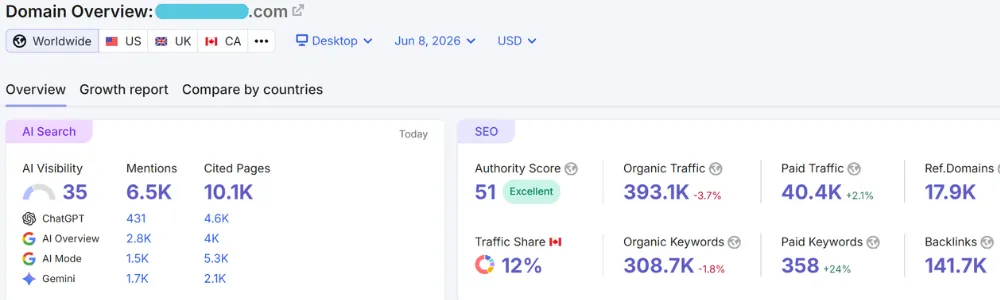
Examples of AI visibility and brand tracking tools include:
- Semrush AI tools
- Ahrefs Brand Radar
- Profound
- Peec AI
- Otterly.AI
- SE Ranking
- Scrunch AI
- Other emerging AI search monitoring platforms
These tools are useful, but they should not replace your own review completely.
Manual testing is still helpful because AI answers can change depending on the prompt, platform, location, and context.
Google Analytics 4 Referral Tracking
You can also track AI-driven referral traffic in Google Analytics 4.
This helps you see whether visitors are coming from platforms such as ChatGPT, Perplexity, Copilot, or other AI search tools.
Referral traffic will not show every AI mention.
Some AI platforms may mention your brand without sending a click.
However, GA4 can help you understand whether AI platforms are starting to send visitors to your website.
Google Search Console Clues
Google Search Console can also provide useful clues.
If your pages are getting more impressions for question-based searches, comparison queries, and informational topics, that may suggest your content is becoming more relevant for AI-style search behaviour.
For example, you may start seeing queries like:
“How to choose an SEO agency”
“Best SEO agency for small business”
“SEO vs Google Ads”
“How much does SEO cost in Canada”
These searches may not prove that your brand is appearing in AI answers, but they can show whether your content aligns with the type of questions people ask AI tools.
Competitor Prompt Tracking
Competitor tracking is another useful method.
Search the same prompts regularly and compare how often your brand appears against your main competitors. This can help you identify visibility gaps, content gaps, authority gaps, and reputation gaps.
For example, if a competitor appears more often than you for “best SEO agency for dentists,” you can review what they have that you do not. They may have a stronger dental SEO page, more case studies, more reviews, more third-party mentions, or clearer service positioning.
Monthly Tracking Sheet
The key is consistency.
AI answers can change, so one test is not enough. Create a simple tracking sheet and review your most important prompts every month.
| Prompt | Platform | Brand Mentioned? | Website Cited? | Competitors Mentioned | Sentiment | Notes |
| Best local SEO agency in Canada | ChatGPT | Yes | No | Competitor A, Competitor B | Positive | Mentioned as a local SEO provider |
| SEO agency for dental clinics | Perplexity | No | No | Competitor A | Neutral | Need stronger dental SEO content |
| Technical SEO company in Toronto | Gemini | Yes | Yes | Competitor C | Positive | Cited technical SEO service page |
| SEO company for moving companies | Copilot | Yes | No | Competitor B | Positive | Mentioned moving company experience |
Over time, this will show whether your AI search visibility is improving, staying the same, or falling behind competitors.
Why AI Search Tracking Is Not 100% Accurate Yet
AI search tracking is useful, but it is not perfect yet.
Unlike traditional Google rankings, AI-generated answers are not always fixed, repeatable, or easy to measure.
With regular SEO tracking, you can usually check where a website ranks for a specific keyword in a specific location. AI search is more flexible.
The answer can change depending on the platform, the prompt, the user’s location, the wording of the question, previous context, and the sources the AI tool decides to use.
AI Answers Can Change Often
Two people can ask the same question and receive different answers.
One prompt may mention your brand, while another may mention only your competitors. Even small wording changes such as “best,” “top,” “recommended,” “affordable,” or “near me” can affect which brands appear.
AI Platforms Use Different Sources
Another challenge is that AI platforms do not always use the same sources.
One platform may rely more on your website. Another may pull from review sites, directories, articles, forums, business profiles, or other third-party sources.
This makes tracking more complex because your visibility depends on your entire online presence, not just your website.
Citations Are Not Always Clear
Some AI platforms show citations clearly. Others may mention your brand without a link.
Your website may influence an answer without being directly cited, or your brand may be mentioned because of third-party content. This makes it harder to measure the full impact of your content.
There Is No Universal AI Visibility Standard
There is also no universal standard for AI visibility yet.
Different tools may track different platforms, prompts, locations, and metrics.
One tool may show that your brand has strong visibility, while another may show limited results because it uses a different tracking method.
That is why businesses should not treat AI search tracking as an exact ranking report. It is better to view it as a visibility and reputation monitoring system.
The goal is not to track AI search perfectly. The goal is to understand whether your brand is showing up, how it is being described, and what you can improve over time.
How to Improve Your Brand Visibility in AI Search
Improving your brand visibility in AI search starts with making your business easier to understand, verify, and trust online.
AI platforms are more likely to mention brands that have clear information, useful content, consistent business details, and strong signals from trusted sources.
Make Your Website Easier to Understand
Your website should clearly explain what you offer, who you help, where you operate, and what makes your company different.
If your website is vague, AI tools may struggle to understand when your brand is relevant.
For example, instead of only saying “We help businesses grow online,” an SEO agency should clearly explain:
- The SEO services it offers
- The industries it serves
- The locations it targets
- The problems it solves
- The results it helps clients achieve
Clear positioning makes it easier for both search engines and AI platforms to understand your business.
Publish Question-Based Content
AI search is heavily driven by conversational questions.
That means FAQ-style content, comparison pages, industry guides, and problem-solving blog posts can help your brand become more relevant for AI-generated answers.
For example, an SEO agency may create content around questions like:
“What is local SEO?”
“How much does SEO cost in Canada?”
“How do I choose an SEO agency?”
“What is the difference between SEO and Google Ads?”
“Which marketing strategy works best for service businesses?”
This type of content matches how people ask questions in AI tools.
Build Third-Party Mentions
Your website is important, but AI platforms may also look at third-party sources.
These can include:
- Business directories
- Review platforms
- Industry websites
- News articles
- Partner websites
- Podcast mentions
- Case studies
- Social profiles
- Local business listings
The more your brand is mentioned across reliable sources, the easier it becomes for AI systems to connect your business with your services and expertise.
Improve Reviews and Business Profiles
Online reviews also matter.
Positive reviews on platforms like Google Business Profile, Clutch, Trustpilot, Facebook, and industry-specific directories can support your brand’s reputation and help AI tools understand how customers describe your business.
Your business profiles should also be complete and consistent. Make sure your company name, website, phone number, address, services, categories, and descriptions match across the web.
Use Structured Data
Structured data can help search engines better understand your website.
Adding schema markup to your website gives clearer information about your organization, services, articles, FAQs, reviews, and local business details.
Schema alone will not guarantee AI mentions, but it can make your content easier for search systems to understand.
Create Comparison and Industry Pages
AI tools often answer comparison-style questions.
That is why businesses should consider creating pages that help users compare options, understand services, and make decisions.
Examples include:
“SEO vs Google Ads”
“Local SEO vs Traditional SEO”
“How to Choose an SEO Agency”
“Best Marketing Strategies for Dental Clinics”
“SEO for Moving Companies”
These pages help position your brand around the questions buyers are already asking.
Keep Your Information Consistent
Inconsistent information can weaken trust.
If your website says one thing, your Google Business Profile says another, and directories show outdated details, AI platforms may struggle to describe your business correctly.
Keep these details consistent:
- Business name
- Website URL
- Phone number
- Address or service area
- Services
- Founder or leadership information
- Business descriptions
- Social profiles
- Review profiles
Consistency makes your brand easier to verify.
AI Brand Mention Tracking Template
Here is a simple template businesses can use to start tracking AI brand visibility.
Step 1: Choose Your Priority Prompts
Start with 10 to 20 prompts your potential customers may ask.
Include different types of prompts:
Service-Based Prompts
“What company offers local SEO services in Canada?”
“Who provides technical SEO audits?”
Industry-Based Prompts
“What SEO agency works with dental clinics?”
“Which marketing company helps moving companies?”
Location-Based Prompts
“Best SEO agency in Toronto”
“Local SEO company in Canada”
Comparison Prompts
“Compare SEO agencies for small businesses”
“Best SEO company vs Google Ads agency”
Branded Prompts
“Is Macro Digital a good SEO agency?”
“What services does Macro Digital offer?”
Step 2: Test Across Multiple Platforms
Test your prompts in:
- ChatGPT
- Gemini
- Perplexity
- Copilot
- Google AI Overviews
- Other AI search tools your customers may use
Step 3: Record the Results
Track whether your brand appears, whether your website is cited, what competitors appear, and how the answer describes your business.
Step 4: Review Monthly
AI search changes over time, so review your most important prompts every month. Look for patterns instead of judging results from one test.
Common Mistakes Businesses Make With AI Search Tracking
AI search tracking is still new, so many businesses make mistakes when they first start.
Only Testing One Prompt
One prompt is not enough.
If you only test “best SEO agency in Canada,” you may miss dozens of other prompts your customers are asking. Use service, industry, location, comparison, and branded prompts.
Only Checking One AI Platform
Different AI platforms can produce different answers.
Your brand may appear in Perplexity but not in ChatGPT. It may appear in Google AI Overviews but not in Gemini. That is why multi-platform tracking is important.
Ignoring Competitors
AI tracking is not only about your own brand.
You should also track which competitors appear, how often they appear, and what sources support their visibility. This helps you understand what you need to improve.
Forgetting About Accuracy
A brand mention is not always good.
If AI describes your company incorrectly, lists the wrong service, or uses outdated information, that can hurt trust. Always review the accuracy of the mention.
Expecting AI Tracking to Be Perfect
AI search is not as stable as traditional rank tracking.
The goal is not perfect measurement. The goal is consistent visibility monitoring, better content, stronger authority, and improved brand understanding over time.
Final Thoughts
Yes, it is possible to track brand mentions in AI search, but businesses need to understand that AI visibility works differently from traditional SEO tracking.
In the past, SEO was mainly focused on keyword rankings, organic traffic, backlinks, and conversions. Those metrics are still important, but AI search adds a new layer.
Brands now need to know whether they are being mentioned in AI-generated answers, how they are being described, whether their website is being cited, and how often competitors appear instead of them.
This does not mean traditional SEO is disappearing. In fact, strong SEO is one of the foundations of AI visibility. Clear website content, helpful blog posts, strong reviews, accurate business profiles, quality backlinks, and third-party mentions can all help AI platforms better understand and trust your brand.
The most important thing is to start tracking early.
AI search is still evolving, but the businesses that monitor their visibility now will have a better chance of understanding where they stand, finding content gaps, and improving their presence before competitors catch up.
Instead of only asking, “Where do we rank on Google?”, businesses should now also ask:
“Does AI search mention our brand when customers are looking for a company like ours?”
That is the future of search visibility.
FAQs About Tracking Brand Mentions in AI Search
Can you track brand mentions in ChatGPT?
Yes, you can track brand mentions in ChatGPT by testing relevant prompts and checking whether your brand appears in the answer. You can also use AI visibility tools to monitor prompts at scale, but manual testing is still useful.
Can you track brand mentions in Google AI Overviews?
Yes, you can track whether your brand appears in Google AI Overviews, but results may vary by query, location, and search context. You should track both brand mentions and website citations when reviewing AI Overview visibility.
What is the difference between AI search tracking and SEO rank tracking?
SEO rank tracking focuses on where your website ranks in traditional search results. AI search tracking focuses on whether your brand is mentioned, cited, described accurately, and compared against competitors in AI-generated answers.
What tools can track AI brand mentions?
Some tools that can help track AI brand visibility include Semrush, Ahrefs Brand Radar, Profound, Peec AI, Otterly.AI, SE Ranking, and other AI search monitoring platforms. However, manual prompt testing is still important because AI answers can change.
How often should you track AI brand mentions?
Most businesses should track AI brand mentions at least once a month. If your industry is competitive, you may want to monitor important prompts more often.
What should I do if AI search does not mention my brand?
Start by improving your website content, creating question-based articles, building third-party mentions, earning more reviews, updating business profiles, and making your services easier to understand. AI platforms need clear and trustworthy information before they can confidently mention your brand.
Do AI brand mentions help with SEO?
AI brand mentions can support your overall search visibility because they show how AI platforms understand and reference your business. They may not work the same way as backlinks or rankings, but they can influence brand awareness, trust, and discovery.
Why does AI search mention my competitors but not my business?
Your competitors may have stronger content, more reviews, better third-party mentions, clearer service pages, stronger authority, or more consistent business information online. Tracking competitor visibility can help you identify what they are doing better.
Is AI search tracking 100% accurate?
No. AI search tracking is not 100% accurate because AI answers can change by platform, prompt, location, and context. It should be used as a visibility monitoring system, not a perfect ranking report.