
Most moving companies rely on word of mouth and paid ads to get jobs.
That works until the ad budget runs out or a competitor outbids you on every click. Search engine optimization gives you a channel that keeps working even when you stop paying for it.
The problem? Most “SEO for movers” guides are generic. They tell you to “do keyword research” and “build backlinks” without explaining how those tactics actually work for a moving company competing in a specific city.
This guide fixes that. Every strategy below is built for the realities of the moving industry: local markets, seasonal demand, high competition, and customers who make fast decisions.
According to Macro Digital’s 2026 SEO research, organic search still drives 53% of all trackable website traffic, and the median three-year ROI on SEO is 748%. The opportunity is real. Here is how to take it.
TL;DR
- Local SEO is the highest-leverage channel for moving companies. Google Business Profile optimization alone can put you in front of customers who are ready to book today.
- Long-tail keywords like “two-bedroom apartment movers in [city]” convert far better than broad terms like “moving company.”
- On-page SEO, fast load times, and mobile optimization are table-stakes requirements, not optional extras.
- Quality backlinks from local directories, real estate blogs, and community sites build the authority that pushes you up the rankings.
- Content marketing helps you capture demand at every stage of the moving journey, from people planning a move months out to people booking same-week.
- SEO is a long-term investment. Most moving companies see meaningful ranking improvements within 3 to 6 months of consistent effort.
Key Stats at a Glance
| Stat | Figure | Source |
| Share of website traffic from organic search | 53% | Macro Digital 2026 SEO Research |
| Median 3-year ROI from SEO | 748% | First Page Sage via Macro Digital |
| “Near me” searchers who contact a business within 24 hours | 76% | Google Consumer Insights |
| Typical timeline to see meaningful SEO results | 3 to 6 months | Industry average |
1. Understand Your Audience and Search Intent
Before you optimize a single page, you need to understand who you are trying to reach and what they are actually searching for.
Moving customers do not all behave the same way online.
A renter looking for help with a local apartment move searches very differently from a business planning an office relocation or a family relocating from one province to another.
Search intent is the reason behind a query.
Google’s algorithm is built to match results to intent, so if your content is optimized for the wrong intent, you will not rank, no matter how good your SEO fundamentals are.
The four intent types that moving customers use
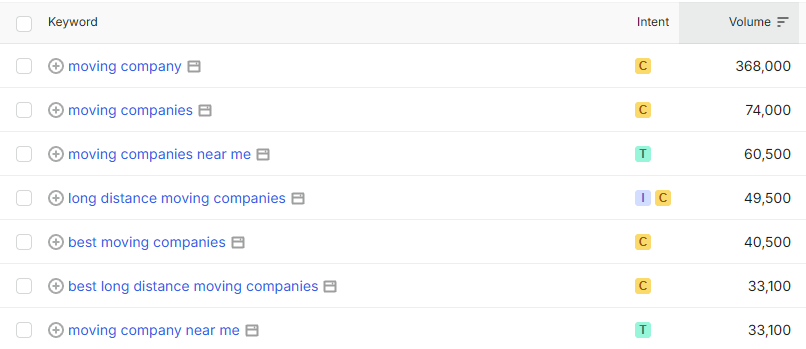
Informational: “How much does it cost to hire movers?” These users are in the planning stage, typically 2 to 8 weeks out. They are not ready to book yet. Target this intent with blog posts, cost guides, and moving checklists. Your goal is to earn their trust before they start comparing companies.
Navigational: “ASR Moving reviews” or “[company name] Toronto.” These users already know your brand and are verifying you. Target this intent with a well-managed Google Business Profile, consistent review responses, and a clean branded presence.
Commercial investigation: “Best moving companies in Vancouver” or “cheapest movers Toronto.” These users are comparing options. Target this intent with service pages that clearly explain your differentiators, pricing structure, and customer reviews.
Transactional: “Movers near me” or “book a moving company today.” These users are ready to hire right now. Target this intent with optimized service and location pages that have a clear phone number, quote form, and fast load time.
How to find out which intent you are currently serving
Use Google Analytics 4 to see which pages are getting organic traffic. Then search the keywords those pages are ranking for and read the top results. If Google is surfacing blog posts for a keyword you have a service page targeting, your page is mismatched to the intent and will struggle to rank.
Tools like Ahrefs and SEMrush also show intent labels next to keywords, which speeds up this audit significantly.
“The biggest mistake moving companies make with SEO is building a site around their services instead of around their customer’s questions. If you are not matching content to intent at every stage of the decision, you are losing people before they ever see your phone number.”
Eli Schwartz, Author of “Product-Led SEO”
2. Keyword Research Built for Moving Companies
Keyword research for a moving company is different from keyword research for an e-commerce store or a SaaS product. Almost every valuable keyword has a local modifier, a service type, or both.
Volume numbers from tools like Google Keyword Planner often look low for local queries, but those “low volume” keywords are the ones that drive actual bookings.
Three keyword categories to build around
Category 1: Local service keywords: These are the core keywords for your service pages. They combine a service type with a city or neighbourhood.
- movers in [city]
- local moving company [city]
- apartment movers [neighbourhood]
- residential movers near me
- same-day movers [city]
Category 2: Long-tail intent keywords: These are more specific and have lower competition. They often signal a user who is deep in the decision process.
- how much do movers cost in [city]
- best moving companies for seniors
- two bedroom apartment movers [city]
- moving company with storage [city]
- cheapest movers in [city] 2026
Category 3: Service-specific keywords: These target customers looking for a particular type of move, not just a generic mover.
- long distance movers [origin] to [destination]
- office relocation services [city]
- piano movers [city]
- packing and unpacking services
- commercial moving company [city]
Keyword comparison: broad vs. targeted
| Keyword | Monthly Searches (Est.) | Competition | Conversion Potential | Priority |
| moving company | 40,500 | Very High | Low | Avoid as primary target |
| movers in Toronto | 1,900 | High | Medium | Service page target |
| apartment movers Toronto | 720 | Medium | High | Primary service page |
| how much do movers cost in Toronto | 390 | Low | High | Blog post target |
| moving company Toronto to Vancouver | 260 | Low | Very High | Dedicated route page |
Notice the pattern. The lower the search volume, the higher the conversion potential.
Someone searching “moving company Toronto to Vancouver” has already decided they need a mover.
They just need to choose one. That is the keyword you want to rank for.
How to find your best keyword opportunities
Start with a list of every service you offer and every city or neighbourhood you serve.
Cross-reference those two lists into keyword combinations.
Then run each combination through SEMrush or Ahrefs to check volume and keyword difficulty.
Sort by difficulty first, then by conversion intent.
The lowest difficulty, highest intent keywords are where you start building pages.
3. On-Page SEO: Optimize Every Service Page
On-page SEO is the work you do directly on your website to help search engines understand what each page is about.
For moving companies, this mostly comes down to your service pages and location pages.
Each one needs to be built to rank for a specific keyword and convert the visitors it brings in.
The on-page SEO fundamentals that matter most for moving company pages are straightforward but often skipped.
On-page SEO checklist for every service and location page
- Primary keyword included in the H1 title, phrased naturally
- Unique meta title under 60 characters with the location name
- Meta description under 160 characters with a clear call to action
- Location name used in at least one H2 or H3 subheading
- LocalBusiness and Service schema markup in JSON-LD format
- Phone number and physical address visible above the fold
- Internal links to related service pages and relevant blog posts
- Image alt text that is descriptive and keyword-relevant
- Customer reviews or testimonials embedded on the page
- FAQ section targeting the most common pre-booking questions
The most common on-page mistake moving companies make
Do not create a single generic “Services” page and try to rank it for every keyword.
Create a dedicated page for each service type and each city you serve. A page for “apartment movers in Scarborough” and a separate page for “office movers in North York” will both outperform a combined page every time.
Google wants to serve users the most relevant result.
A page written specifically about apartment moves in Scarborough is more relevant to that search than a page that mentions it in one paragraph alongside fifteen other services.
Internal linking on service pages
Every service page should link to at least two or three related pages on your site.
If you have a page for “long-distance movers Toronto to Calgary,” it should link to your general long-distance moving page, your packing services page, and ideally a blog post like “what to expect on a cross-province move.”
These links distribute authority across your site and keep users exploring.
Macro Digital’s 2026 SEO research confirms that pages with strong internal link structures consistently outrank thin, isolated pages in competitive local markets.
4. Local SEO: Win the Map Pack
For moving companies, local SEO is the most important channel on this entire list. When someone types “movers near me” or “moving company Toronto,” Google shows a map with three local results before any organic listings.
That Map Pack gets the majority of clicks. If you are not in it, you are invisible to the most ready-to-buy customers.
According to Macro Digital’s 2026 SEO research, local searches with commercial intent have one of the highest conversion rates of any traffic source, with 76% of “near me” searchers visiting or contacting a business within 24 hours.
What determines your local ranking?
Based on the Whitespark Local Ranking Factors report, here is how the major signals weigh out:
| Ranking Factor | Relative Importance |
| Google Business Profile completeness and activity | 88% |
| Reviews (quantity, recency, and response rate) | 76% |
| On-page local signals (NAP, location keywords, schema) | 65% |
| NAP consistency across the web | 55% |
| Local citations and directory listings | 48% |
| Behavioural signals (clicks, calls, directions) | 40% |
Google Business Profile: the non-negotiable
Your Google Business Profile is the single most influential factor in your local ranking.
Treat it like a second website:
- Choose “Moving Company” as your primary category and add relevant secondary categories like “Storage Facility” or “Packaging Supply Store” if applicable
- Write a full business description with your city name, the types of moves you handle, and how many years you have been operating
- Add photos of your trucks, your team on job sites, and completed moves. Profiles with 10 or more photos get significantly more views than those with fewer
- Publish Google Posts at least once a week. These show up in your profile and signal to Google that your listing is active
- Respond to every review within 24 hours, positive and negative. Your response rate is a ranking signal and a trust signal for potential customers
- Enable messaging and answer incoming questions quickly
Citations and NAP consistency
A citation is any online mention of your business name, address, and phone number.
List your business on Yelp, Angi, HomeStars, the Better Business Bureau, Yellow Pages, and any local business directories in your city.
The key is consistency: your name, address, and phone number must be identical across every platform.
Even small differences like “St.” versus “Street” or “647-555-0100” versus “(647) 555-0100” can dilute your local authority.
Use a tool like BrightLocal or Whitespark to audit your existing citations and flag any inconsistencies before you build new ones.
5. Build Backlinks That Actually Move the Needle
Backlinks are links from other websites pointing to yours.
They are one of Google’s strongest ranking signals because they represent trust.
A link from a reputable Toronto real estate blog to your moving company site tells Google that your business is legitimate and worth recommending.
The moving industry has strong natural backlink opportunities that most companies ignore.
Here is how to prioritize them by quality:
Backlink source quality tiers
Tier 1: Local news and community sites (very high quality)
Sponsor a local event, donate to a community cause, or reach out to local journalists covering home and lifestyle stories.
When your company gets mentioned in a local news article, you almost always earn a link.
These are high-authority, geo-relevant links that directly support your local rankings.
Tier 2: Real estate and relocation blogs (high quality)
Real estate agents, mortgage brokers, and relocation consultants all publish content for people who are moving.
Reach out and offer a guest post on topics like “how to choose a mover” or “what to ask before hiring a moving company.”
These links are topically relevant and come from audiences with immediate moving intent.
Tier 3: Home services and moving directories (medium quality)
Yelp, Angi, Houzz, HomeStars, and MovingScam.com all provide directory listings with a link back to your site.
These are easy wins with low effort and directly support your citation profile.
Tier 4: Complementary local businesses (medium quality)
Storage facilities, cleaning companies, real estate agents, and home stagers all serve people who are moving.
Cross-link with trusted local partners.
These are natural, relevant, and easy to build through existing business relationships.
Tier 5: Paid link schemes (harmful, avoid entirely)
Purchased links and private blog networks may show short-term ranking gains but will eventually trigger a manual penalty.
The risk is not worth it for a local business building a long-term reputation.
Guest blogging for moving companies
Guest blogging on relevant websites is one of the most reliable ways to earn quality links at scale.
Reach out to local real estate blogs, home organization sites, and neighbourhood community pages.
Offer to write a genuinely useful article, like “What to look for when hiring a moving company” or “How to prepare your home for moving day.”
In return, you earn a contextual link using keyword-relevant anchor text.
Even one quality guest post per month compounds significantly over a 12-month period.
6. Technical SEO: Fix the Foundation
Technical SEO is the behind-the-scenes work that makes your website easy for Google to crawl, index, and rank.
You can write the best content in your market, but if your site is slow, broken on mobile, or full of crawl errors, it will not perform.
“Page experience is a real ranking signal. A moving company with a two-second load time will consistently outrank a competitor with a four-second site, all other things being equal. Speed is not a nice-to-have. It is a baseline requirement.”
John Mueller, Search Advocate, Google
Core technical priorities for moving company websites
Page speed: Use Google PageSpeed Insights to test your site.
Compress images before uploading them, minimize CSS and JavaScript files, and consider a content delivery network (CDN) if you serve multiple cities.
Aim for a load time under 3 seconds on mobile.
Most moving company websites fail this test because of uncompressed hero images and bloated page builders.
Mobile optimization: Over 70% of “movers near me” searches happen on a phone.
Your site must work perfectly on small screens.
Tap targets should be large enough to press with a thumb, text should be readable without zooming, and your phone number should be a clickable tel: link.
HTTPS security: If your site is not secured with an SSL certificate (the padlock icon in the browser bar), fix this immediately.
Google gives a ranking preference to secure sites, and customers will not trust a moving company website that their browser flags as “Not Secure.”
Structured data: Add LocalBusiness and Service schema markup to your pages in JSON-LD format.
This helps Google understand your business type, service areas, hours, and pricing, and can unlock rich results in search, like star ratings and business hours appearing directly in the results.
Crawl errors: Use Google Search Console at least once a month to find and fix broken links, redirect chains, and pages that cannot be indexed. A moving company site with 404 errors on its service pages is leaking authority and losing rankings it should be winning.
Core Web Vitals: Google’s CWV metrics measure loading performance (Largest Contentful Paint), interactivity (Interaction to Next Paint), and visual stability (Cumulative Layout Shift). Poor scores can suppress your rankings even if everything else is strong. Search Console’s Core Web Vitals report shows you exactly which pages are failing and why.
7. Content Marketing That Captures Every Stage
Content marketing for moving companies works best when it is mapped to the stages of the customer journey.
Someone who googled “how to choose a moving company” two months ago might be searching “movers in [city]” today.
If your content captured them at the research stage, they are more likely to remember and trust your brand when they are ready to book.
A well-built content strategy also compounds over time.
Each blog post, guide, and city page you publish is another entry point to your site.
According to Macro Digital’s 2026 SEO research, service businesses that publish consistent content generate 44.6% of their revenue through organic channels.
Content types mapped to the customer journey
Top of funnel (awareness): blog posts and guides: These target informational keywords from people who are planning a move but not ready to hire yet. Topics that work well:
- “How much do movers cost in [city]?”
- “Moving checklist: what to do 30 days before moving day”
- “Best neighbourhoods to move to in [city] in 2026”
- “How to pack a kitchen for a move without breaking anything”
- “Should you hire movers or rent a truck? A cost comparison”
Middle of funnel (consideration): comparison and specialty pages: These target commercial investigation keywords from people comparing their options. Topics that work well:
- “What to look for when hiring a moving company”
- City-specific service landing pages with local testimonials
- “Office relocation vs. residential moving: what is different”
- “Questions to ask your moving company before you book”
Bottom of funnel (conversion): service and location pages: These target transactional keywords from people who are ready to hire. Every page in this category needs a clear headline, a visible phone number, a fast quote form, and customer reviews. Pages that work well:
- Apartment movers [city]
- Long-distance movers from [city] to [city]
- Commercial moving services [city]
- Same-day movers [city]
- Senior moving services [city]
Retention and referral: reviews and email: The move is done, but the customer relationship is not. A well-timed email marketing campaign asking for a review, or a follow-up with storage or cleaning service recommendations, keeps your brand top of mind for referrals and repeat moves.
Writing for stressed people
Most people searching for movers are in the middle of one of the most stressful events of their year. They do not want to read dense walls of text. Write short paragraphs. Use numbered lists and subheadings so readers can scan and find what they need quickly. Aim for a Grade 6 to 8 reading level across all your content. Tools like Hemingway App can help you check this before publishing.
8. Track, Measure, and Keep Improving
SEO is not a one-time project. It is an ongoing process. Rankings shift, competitors improve their sites, and Google updates its algorithm. The only way to stay ahead is to track your performance consistently and adjust based on what the data tells you.
The four metrics that matter most for moving company SEO
| Metric | What it tells you | Tool to use | Review frequency |
| Organic traffic | How many visitors are arriving from search and which pages are driving them | Google Analytics 4 | Weekly |
| Keyword rankings | Where your key service and location pages are ranking for target keywords | SEMrush, Ahrefs, or Search Console | Weekly |
| Conversion rate | What percentage of organic visitors are requesting a quote or calling | Google Analytics 4 with goal tracking | Monthly |
| Local pack visibility | How often does your Google Business Profile appear in local results | Google Business Profile Insights | Monthly |
How to respond when rankings drop
Set a baseline in month one, then track changes month over month.
If your rankings drop after a Google update, use Search Console’s Performance report to identify which pages lost visibility.
Look for patterns: are all the affected pages in one topic area? Did a specific type of content get hit? Refresh the content on the affected pages, improve load speed, and add internal links from stronger pages to help recovery.
Do not make multiple changes at once when diagnosing a drop.
Change one thing, wait two to three weeks, and measure the result.
Making three changes simultaneously means you will never know which one worked.
Dealing with content decay
Content decay is real in the moving industry.
A blog post on “average moving costs in Toronto” written in 2022 may contain outdated pricing data.
A guide to “best moving companies in Vancouver” that has not been updated may be recommending businesses that have since closed.
Revisit your top-performing content at least once a year.
Update the stats with fresh data, replace any broken links, refresh the examples, and republish with an updated date.
A well-maintained older post often recovers and surpasses its original rankings after a refresh.
Putting It All Together
No single strategy on this list will transform your moving company’s online presence overnight.
But working through all eight, starting with local SEO and keyword research and building toward content and technical optimization, creates a compounding advantage that paid advertising cannot replicate.
The moving companies that win in search are not necessarily the biggest.
They are the most consistent. They publish content regularly, keep their Google Business Profile updated, fix technical issues quickly, and build relationships that earn backlinks naturally over time.
Start with your Google Business Profile today. Then, audit one service page against the checklist in Strategy 3.
Then write one blog post targeting a specific long-tail keyword from Strategy 2. Each step builds the foundation for the next.
Need help building a strategy tailored to your market? Explore Macro Digital’s SEO services for local businesses or review the 2026 SEO statistics that should be shaping your priorities this year.
Is your moving company invisible on Google?
Macro Digital specializes in SEO for local service businesses. Get a free audit of your current rankings, your Google Business Profile, and the biggest opportunities your competitors are missing.
Frequently Asked Questions
How long does SEO take to work for a moving company?
Most moving companies see noticeable improvements in rankings and traffic within 3 to 6 months of consistent effort.
Local SEO improvements, especially Google Business Profile optimization, can show results faster, sometimes within weeks.
Long-tail keyword rankings typically appear within 2 to 4 months.
Competitive city-level keywords like “movers in Toronto” can take 6 to 12 months to crack the first page.
Should I target one city or every city I serve?
You should create dedicated pages for every city or neighbourhood you actively serve.
A single “Service Areas” list is not enough.
Each city page needs its own URL, unique content describing your services in that area, and local keyword optimization.
Start with your highest-revenue markets and expand from there.
How many reviews do I need to rank in the Google Map Pack?
There is no fixed number, but competitors in most Canadian cities rank in the Map Pack with 50 to 200 reviews.
More important than the total count is recency and response rate.
A profile with 60 reviews from the past 12 months and responses to all of them will typically outperform a profile with 200 old reviews and no responses.
Do I need a blog if I already have good service pages?
Yes. Service pages capture transactional intent, but blog content captures the informational searches that happen earlier in the customer journey.
People planning a move weeks or months out are searching for advice, cost estimates, and tips. Blog content brings those people to your site before they start comparing competitors.
Can I do SEO myself or do I need to hire an agency?
You can handle many SEO tasks yourself, including Google Business Profile management, basic on-page optimization, and content publishing.
However, technical SEO, competitive keyword research, and link building typically require tools and expertise that take time to develop.
Many moving companies see the best results by handling content in-house and partnering with a specialist agency for technical and off-page work.
What is the single highest-impact SEO action I can take today?
Fully optimize your Google Business Profile. Add photos, write a complete description with your city and services, set your service areas, enable messaging, and request reviews from your last 10 completed jobs.
This one action influences your Map Pack ranking more than almost anything else and can produce visible results within weeks.