
If you only have two minutes, here is what actually moves the needle in SEO for law firms:
- Your Google Business Profile is the single biggest lever you control. Start there, and pick the most specific practice-area category available.
- Reviews are a ranking factor, not just social proof. Volume and recency matter more than a one-time burst.
- Chase intent, not traffic. A handful of high-intent local pages will out-earn a hundred generic blog posts.
- Consistent name, address, and phone (NAP) data across directories builds the trust signals Google looks for.
- Be patient. Expect 4–6 months for early traction and 12–18 months to compete in the top three of a major metro.
When someone needs a lawyer, they rarely ask for a referral first.
They reach for their phone and type something like “divorce lawyer near me” or “car accident attorney free consultation” into Google.
Whichever firm shows up in those first few results has a real shot at the case. Everyone else is invisible.
That is the entire premise of lawyer SEO, and the data backs it up. Industry research consistently finds that nearly all consumers search online for local services, and a large share of “near me” legal searches happen on mobile with clear hiring intent.
Roughly 46% of all Google searches have local intent, and for legal services, that share is even higher because most clients want someone nearby and licensed in their jurisdiction.
This guide walks through how lawyers get more clients online through search, drawn from patterns we see across 200+ law firm SEO audits at Macro Digital.
It is organized the way you should tackle the work: foundation first, then the elements that compound over time.
If you want the bigger-picture marketing view, our law firm digital marketing strategy guide covers paid, email, and brand alongside search.
Why Lawyers Need SEO
Most legal hiring decisions now start with a search.
A prospective client with an urgent legal problem does not flip through a directory; they search, they scan the first few results, and they call.
If your firm is not visible at that moment, the case goes to whoever is.
SEO for lawyers is also durable in a way that paid advertising is not.
A Google Ads campaign stops the day you stop paying; the rankings you have built keep working.
Legal keywords carry some of the highest costs-per-click in all of paid search, which makes strong organic visibility disproportionately valuable. And because legal services are local by nature, attorney SEO is largely local SEO, which means a well-run small firm can genuinely outrank a larger competitor with a bigger budget.
Common Myths That Hold Law Firms Back
Before the strategy, it helps to clear up the misconceptions we hear most often in audits. Each one quietly costs firms cases.
Myth 1: “You need 100+ blog articles to rank”
Volume is not the goal. We regularly see firms with a dozen well-targeted pages outperform competitors with hundreds of thin blog posts.
Google rewards relevance and depth, not word count across your domain.
One thorough, locally focused page on a practice area will usually beat fifty generic “what is personal injury law” explainers.
Myth 2: “Reviews are just for credibility”
Reviews are both. They build trust with prospective clients and function as a genuine local ranking signal.
In Whitespark’s 2026 Local Search Ranking Factors report, review signals, including recency rank, are among the most influential factors for local pack visibility.
A firm with a steady stream of recent reviews has a real edge over one with a higher star count but nothing new in a year.
Myth 3: “Hire an agency and forget about it.”
SEO is not a set-and-forget purchase. The firms that win treat their agency as a partner and stay involved in strategy, intake, and reporting.
If a lawyer SEO agency cannot show you law firm clients they have ranked in the last 12 months, that is a fair reason to keep looking.
We cover how to vet agencies properly later in this guide.
Myth 4: “SEO results come in 90 days”
Realistic timelines matter. Most firms should expect 4–6 months for initial traction and 12–18 months to compete for the top three in a competitive metro.
Smaller markets move faster. Anyone guaranteeing first-page rankings in 30 days is overpromising.
Myth 5: “More traffic means more clients”
Traffic without intent is a vanity metric.
We have audited firms whose previous agency “tripled their traffic” with blog posts on topics like the history of divorce law, and visitors with zero intent to hire.
A page that brings in 50 visitors searching “[city] divorce lawyer cost” will typically generate more signed cases than one bringing in 2,000 visitors searching “what is no-fault divorce.”
Measure leads, not sessions.
What Law Firm SEO Actually Is

Law firm SEO is the work of making your firm visible when potential clients search Google for legal help in your area.
Google decides local rankings using three broad signals:
- Relevance: how well your firm matches what the person is searching for.
- Proximity: How physically close your office is to the searcher.
- Prominence how credible, authoritative, and well-reviewed your firm appears online.
Proximity is the one you cannot change; your office is where it is.
But you can build relevance and prominence so thoroughly that proximity becomes less decisive. In competitive markets, that is exactly what the winning firms do.
One more thing worth naming up front: legal content is a YMYL (“your money or your life”) category, so Google holds it to a high E-E-A-T bar experience, expertise, authoritativeness, and trustworthiness.
Visible attorney credentials, real case experience, and genuine authorship are not optional niceties; they are part of how legal pages earn rankings at all.
Building an SEO Strategy for Attorneys: Choosing Keywords That Convert Cases
Most firms target the wrong keywords, broad, hyper-competitive terms like “personal injury law” that bring traffic but rarely a signed retainer.
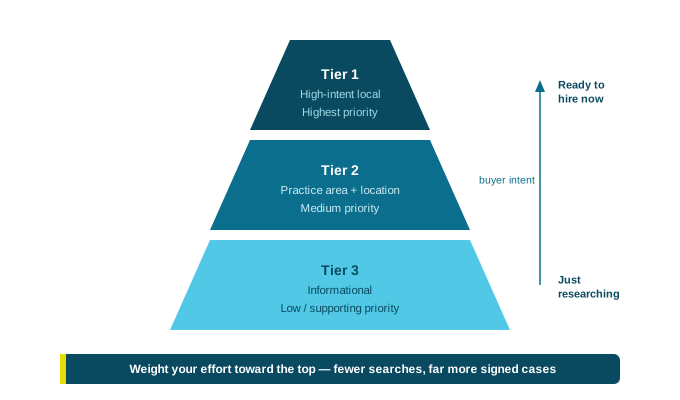
A sound SEO strategy for attorneys starts by sorting keywords into three intent tiers and weighting your effort accordingly.
| Tier | Example keywords | Typical intent | Priority |
| Tier 1 High-intent local | “divorce lawyer [city] free consultation”, “DUI attorney near me”, “personal injury lawyer [city] no fee” | Ready to hire now | Highest |
| Tier 2 Practice area + location | “family law attorney [city]”, “criminal defense lawyer [city]” | Comparing options | Medium |
| Tier 3 Informational | “How much does a divorce cost?” “What is personal injury?” | Researching, not hiring | Low / supporting |
The common mistake is building an entire website around Tier 3 content because “you need content,” then wondering why thousands of monthly visitors produce only a couple of calls.
Tier 1 and Tier 2 terms have lower search volume, but the people behind them are far closer to picking up the phone.
How to research keywords the right way
- Listen to your intake calls: The exact phrases callers use, “my boss fired me for no reason,” are how real people search, not “wrongful termination attorney.”
- Check Google autocomplete: Type your practice area plus your city, and note what Google suggests. Those are real, active searches.
- Study competitors who outrank you: Run their URLs through a tool like Semrush or Ahrefs and look for terms they rank for that you do not.
- Target “near me” and geographic variations: A large share of local legal searches include “near me” or a place name. For more on this, see our explainer on local search intent.
Group related terms into clusters so each page targets one primary keyword plus its natural variation, for example, a Miami personal injury page covering “Miami personal injury attorney,” “car accident lawyer Miami,” and “Miami accident attorney free consultation.”
If your focus is on intake volume specifically, our guide on how to get personal injury leads online goes deeper on turning these searches into signed cases.
Google Business Profile for Lawyers: Where Most Local Wins Happen
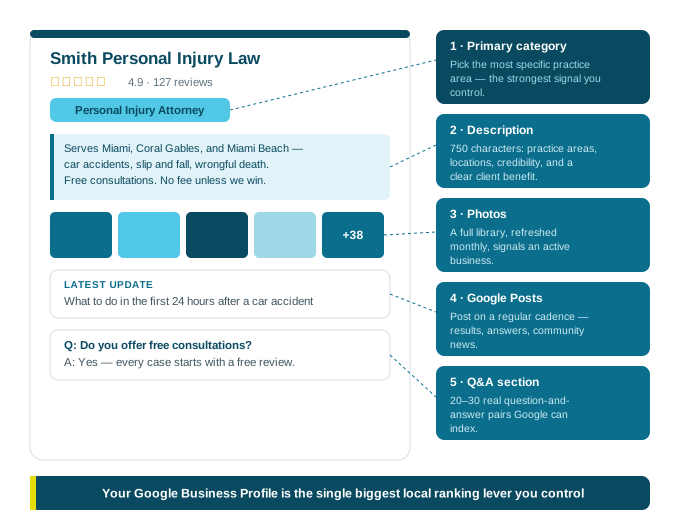
Across the local SEO industry, there is broad agreement that your Google Business Profile is the single biggest driver of local pack visibility, the three map results that sit above the organic listings.
Whitespark’s 2026 ranking factors report identifies the profile and the primary category in particular as among the strongest signals a firm actually controls.
Yet in audits, we routinely see profiles that have not been touched in over a year.
Setting up the Google Business Profile for lawyers correctly is the highest-leverage hour you can spend.
1. Category selection is make-or-break
Do not settle for “Lawyer” or “Attorney.” Choose the most specific practice-area category Google offers and note that Google has been adding niche legal categories like “Probate Attorney” and “Estate Litigation Attorney.” Common strong choices include:
- Personal Injury Attorney
- Family Law Attorney
- Criminal Defense Attorney
- Estate Planning Attorney
In one audit, a San Diego personal injury firm changed its primary category from “Attorney” to “Personal Injury Attorney” and nothing else, and saw a meaningful jump in local pack position within a couple of weeks. (Results vary; this is an illustrative anonymized client example, not a guarantee.)
2. Write a description that earns its 750 characters
A vague description, “serving the community since 1995 with quality legal services,” tells Google and clients nothing.
A strong one names specific practice areas, the exact communities you serve, a concrete credibility signal, and a clear client benefit (free consultations, no fee unless we win, available 24/7). Specificity is what makes the field work for you.
3. Add photos consistently
Profiles with photos tend to get more engagement.
One legal marketing analysis found that firms refreshing their profile with new photos and posts saw roughly 35% more website clicks and 42% more direction requests.
Aim for a solid library office exterior and interior, attorney headshots, team photos, awards, and add a few new images each month so Google keeps seeing an active business.
4. Use Posts and the Q&A section
Post on a regular cadence case results where ethically appropriate, answers to common legal questions, service highlights, and community involvement.
Then build out the Q&A section with 20–30 genuine question-and-answer pairs (“Do you offer free consultations?”, “How long do cases take?”).
Google indexes that content, and prospective clients who see their exact question answered are far more likely to call.
Local SEO Strategies for Lawyers: Reviews
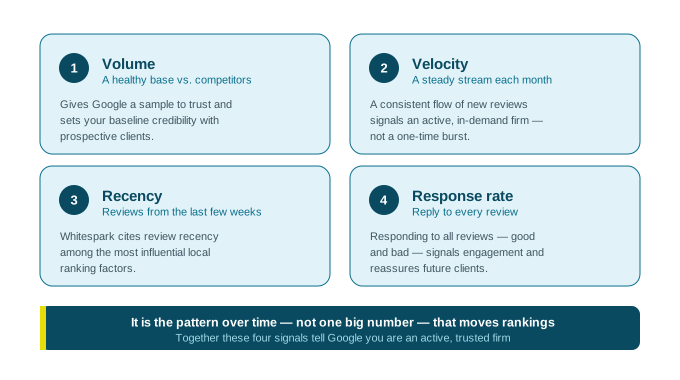
Reviews remain central to both rankings and conversions. BrightLocal’s most recent consumer research found that 97% of consumers read online reviews when researching local businesses, and review-reading has become more important year over year, not less. For law firms, where trust is the whole product that matters enormously.
What actually moves rankings is less about a single big number and more about the pattern over time:
| Factor | What to aim for | Why it matters |
| Volume | A healthy base relative to competitors in your market | Establishes baseline credibility and gives Google a sample to trust |
| Velocity | A steady stream of new reviews each month | Recent activity signals an active, in-demand business |
| Recency | Reviews from the last few weeks, not just years ago | Whitespark cites review recency among the most influential local factors |
| Response rate | Reply to every review, positive or negative | Signals engagement to Google and reassures prospective clients |
Build a simple, repeatable review system
“We ask sometimes” is not a system. A workable one has three steps:
- Identify peak satisfaction moments: Just after a positive outcome, when a client expresses gratitude, or right after a matter closes.
- Make it effortless: Send a direct, clickable Google review link, not written instructions, in a short, warm email a day or so after the matter closes. Follow up once if there is no response.
- Train your staff: Receptionists and paralegals can mention reviews naturally at the right moment. One sincere sentence converts a surprising share of happy clients.
Handling negative reviews
Respond professionally within about 24 hours, acknowledge the concern, and move the conversation offline to your office manager.
Never argue publicly, never reveal case details (a confidentiality issue), and never ignore it.
A measured response is really for everyone else reading, and most consumers are willing to give a business another look when it responds well.
A clear line you should not cross
Never buy reviews, offer incentives for them, or use any service that violates Google’s terms.
Google actively detects fake review activity, and the penalty removal from local search can wipe out a firm’s lead flow overnight and take months to recover from. It is not worth it.
Local Citations: Tedious Work That Compounds
Citations are mentions of your name, address, and phone number (NAP) across directories and websites.
They are not glamorous, and their weight has softened somewhat as Google leans more on reviews and engagement signals, but they still matter for trust and consistency, and inconsistent NAP data actively works against you.
The NAP consistency rule
Your name, address, and phone number should be identical across every platform down to punctuation.
The kinds of inconsistencies that cause problems:
- “Smith Law Firm” vs “Smith Law Firm, LLC” vs “The Smith Law Firm”
- “Suite 100” vs “Ste 100” vs “#100”
- “(555) 123-4567” vs “555-123-4567”
In one audit, a family law firm had more citations than its competitors but dozens of conflicting NAP variations and was nearly invisible in local search.
Standardizing everything to one consistent record produced a clear ranking improvement over the following weeks.
The building process
- Create a master NAP record: Document exactly how your information should appear everywhere. This is your single source of truth.
- Build core citations first: Google Business Profile, Bing Places, Apple Maps, and Yelp, then the legal directories: Avvo, Martindale-Hubbell, Justia, FindLaw, and Lawyers.com.
- Submit to data aggregators: Aggregators distribute your data to many smaller directories automatically, which saves a great deal of manual work.
- Audit quarterly: Directories change, merge, and shut down. A quarterly check keeps everything accurate.
Industry guidance generally points to building citations across 60–70+ directories for competitive markets, with fewer needed in smaller ones.
The exact count matters less than accuracy and consistency.
Law Firm Content Marketing That Ranks (Not Generic Blog Fluff)
Plenty of firms publish generic posts, see little traffic, generate no cases, and conclude “content doesn’t work.”
The real problem is usually that the law firm’s content marketing was not built around intent or local context.
Service pages are your highest priority
Build one comprehensive page per practice area, optimized for local keywords.
A reliable structure:
- H1: [Practice Area] Attorney in [City] | [Firm Name]
- H2: What is [practice area] law?
- H2: How [practice area] cases work in [state]
- H2: Why choose our [practice area] attorneys
- H2: Results we have achieved
- H2: Frequently asked questions
Aim for roughly 1,500–2,500 words with genuine local references throughout the keyword in the H1, the communities you serve, a credibility signal, and real local context in the opening lines.
Blog content: lower priority, used strategically
Blog posts should target the long-tail questions clients actually ask, with local context built in. “What is personal injury law?” is generic and competitive. “How much is my car accident case worth in [state]?” targets real intent.
A cadence of two to four genuinely useful posts a month beats a high-volume content mill every time.
Our on-page SEO checklist is a good companion when you are building these pages out.
The most common content mistake
Most law firms write for other lawyers, legal jargon, case citations, and doctrinal nuance.
Meanwhile, the prospective client just wants to know, “Can I sue my employer for this?” Write at roughly an 8th-grade reading level.
“Pursuant to the doctrine of respondeat superior…” becomes “Yes, you can usually sue your employer if their employee injured you while working.” The plain version ranks better and converts better.
Attorney Website Optimization: The Technical Foundation
You can have the best content in your market, but if your site is slow on mobile, it will struggle to rank.
Google uses mobile-first indexing, and mobile drives the large majority of legal search traffic, so attorney website optimization is not a back-office detail; it is a ranking factor.
Mobile optimization
Page speed is the priority. Quick wins that consistently help:
- Compress images and serve them in modern formats like WebP
- Minimize and defer non-critical JavaScript and CSS
- Enable browser caching
- Use a content delivery network (CDN)
Also, make your phone number tap-to-call on every page.
A large share of mobile searchers call directly from results, and a prominent click-to-call button removes friction at exactly the moment intent is highest.
Schema markup
Schema is structured code that helps Google understand your pages and can produce rich results, review stars, FAQ snippets, and enhanced listings.
The essential types for a law firm:
- LocalBusiness / Attorney / LegalService schema communicates NAP, hours, and practice areas
- Review schema can surface star ratings in search results
- The FAQPage schema targets the People Also Ask box and featured snippets
Validate your markup with Google’s Rich Results Test once it is live so you know it is actually being read.
How to Rank a Law Firm on Google: Measuring What Matters
Plenty of firms celebrate “traffic is up 50%” while leads stay flat. Traffic without conversions is worthless.
Knowing how to rank a law firm on Google is only half the job; knowing whether it is working is the other half. Focus your reporting on four areas:
- Google Business Profile metrics: Discovery searches, phone calls from the profile, direction requests, and website visits. If discovery rises but calls do not, the profile needs work.
- Google Analytics is focused on quality: Organic traffic from your target city, traffic to service pages (not blog posts), and goal completions for forms and calls.
- Local rank tracking: Track your 10–20 target keywords by specific location using a geo-aware tool like Local Falcon or BrightLocal standard rank trackers, which miss neighborhood-level variation.
- Conversion metrics: Monthly organic leads, lead-to-consultation rate, consultation-to-retained rate, average case value, and cost per acquisition. These are the numbers that tell you whether SEO is paying off.
SEO ROI for Law Firms: A Realistic Timeline
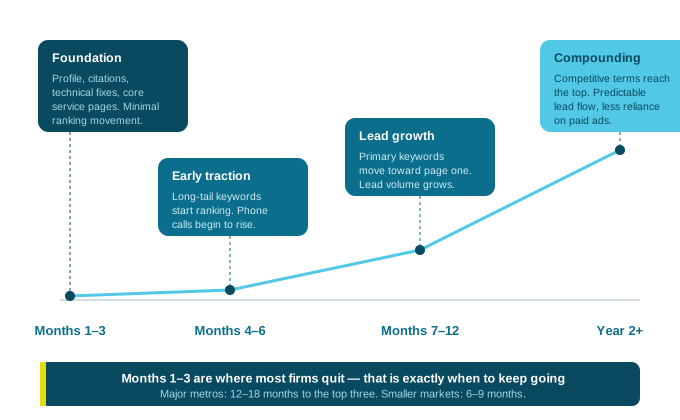
SEO compounds, which means it is slow at the start and accelerates later. Independent legal marketing benchmarks broadly agree that organic SEO takes 3–6 months to show ranking movement, with stronger ROI building over the following year. Here is a realistic arc:
| Phase | What is happening | What to expect |
| Months 1–3 | Foundation building profile, citations, technical fixes, core service pages | Minimal ranking movement; this is where most firms quit |
| Months 4–6 | Early traction; long-tail keywords begin to rank | Phone calls start to increase |
| Months 7–12 | Primary keywords move toward the first page | Lead volume grows noticeably |
| Year 2+ | Competitive terms reach the top of the results | Predictable lead flow; less reliance on paid ads |
In major metros, New York, Los Angeles, Chicago, Miami, and Toronto expect 12–18 months to compete for the top three.
Smaller markets often compress that to 6–9 months.
The SEO ROI for law firms is strong once it compounds, but any promise of fast results in a competitive market should be treated with skepticism.
Hiring a Lawyer SEO Agency: How to Find the Best SEO Agency for Lawyers
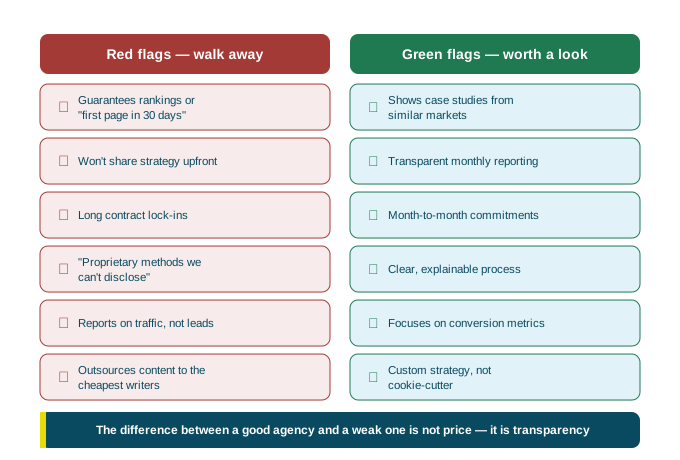
There are excellent law firm SEO services, and there are weak ones, and the difference is not price.
Whether you are evaluating a full-service SEO company for lawyers or a specialist, here is how to tell them apart.
| Red flags | Green flags |
| Guarantees rankings or “first page in 30 days.” | Shows case studies from similar markets |
| Won’t share strategy upfront | Transparent monthly reporting |
| Long contract lock-ins | Month-to-month or short commitments |
| “Proprietary methods we can’t disclose” | Clear, explainable process |
| Reports on traffic instead of leads | Focuses on conversion metrics |
| Outsources content to the cheapest writers | Custom strategy, not cookie-cutter |
Questions to ask before you hire
- Can you show me three law firm clients you have ranked in competitive markets in the last 12 months?
- What does your process look like for the first 90 days?
- How do you measure success?
- Who actually does the work?
- What happens if I don’t see results in six months?
If an agency dodges these, keep looking.
The best SEO agency for lawyers will answer all five without hesitation.
DIY vs hiring an SEO agency for law firms
| DIY can work if… | Hire an agency if… |
| You have 15–20 hours a week to commit | You don’t have time for consistent execution |
| You are willing to learn the technical side | You are in a major metro with well-funded competitors |
| Your market is not ultra-competitive | You tried DIY for six months with no results |
| You have a budget for tools ($500–1,000/month) | Your time is better spent practicing law |
Your Law Firm SEO Checklist: Three Actions for Today
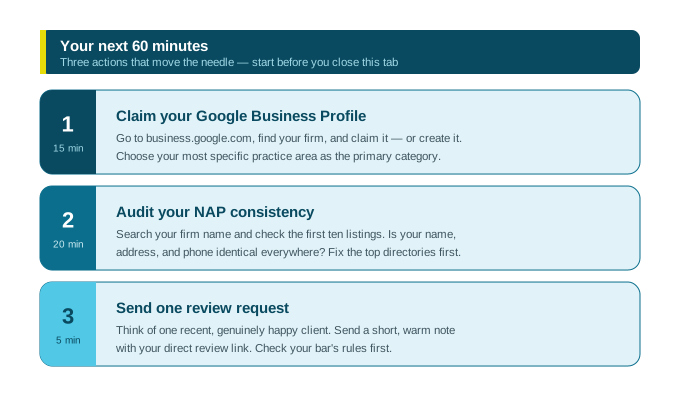
If you want to make progress today, here is the short version of the law firm SEO checklist: start here.
1. Claim your Google Business Profile (15 minutes)
Go to business.google.com, search for your firm, and claim it or create it if it does not exist.
Choose your most specific practice-area category as the primary category.
2. Audit your NAP consistency (20 minutes)
Search your firm name and check the first ten listings.
Are your name, address, and phone number identical on all of them, down to punctuation?
Document the inconsistencies and fix the top directories first: Google, Bing, Apple Maps, Yelp, Facebook.
3. Send one review request (5 minutes)
Think of a recent, genuinely happy client and send a short, warm note asking them to share their experience on Google, with your direct review link.
One request. (And per the note above, confirm your bar’s rules on review solicitation first.)
How to Market a Law Firm Online: The Long Game Wins
SEO is not a hack. It is compound interest for your firm’s visibility.
The attorneys dominating Google in their markets today started the work a year or two ago; they did not wait for the perfect agency or the perfect plan, they committed to consistent execution.
If a competitor is signing cases that could have been yours, it is rarely because they are the better lawyer.
It is because they show up when potential clients search.
Knowing how to market a law firm online comes down to this: the strategy in this guide is proven, and the tools are accessible.
The only real question is whether you will do the work or have a partner do it with you.
Frequently Asked Questions
How much does lawyer SEO cost?
Roughly $500–2,000 a month for a DIY approach with tools, or $3,000–10,000 a month for a law firm SEO services provider, depending on market competitiveness.
In most practice areas, a single new client covers the monthly investment.
How long does law firm SEO take to work?
Expect 4–6 months for initial improvements and 12–18 months to compete for the top three in a competitive market.
Smaller markets move faster. Any promise of 90-day first-page rankings should be treated with caution.
What is the most important law firm SEO ranking factor?
Your Google Business Profile and especially the primary category are widely regarded as the strongest local signal a firm controls.
Can small firms compete with big firms on SEO?
Yes. Local SEO weighs relevance and prominence over firm size, so thorough optimization can beat a bigger budget.
How many Google reviews do I need?
There is no magic number. What matters most is velocity and recency, a steady stream of new reviews relative to your competitors, rather than a one-time burst.
Should I hire an SEO agency for law firms or do it myself?
DIY can work if you have 15+ hours a week and are not in an ultra-competitive metro.
Hire a lawyer SEO agency if your time is better spent practicing law, and you can vet providers properly.
Do blog posts help SEO for law firms?
Only when they target real search intent with local context.
Generic legal explainers rarely move rankings or generate leads.
How important is website speed?
Very. Google uses mobile-first indexing and mobile drives most legal search traffic, so a slow mobile site is a real ranking liability.
Can I rank for multiple cities?
Yes, but each city needs its own page with genuinely distinct, locally relevant content.
Duplicating a page with only the city name swapped does not work.