
TL;DR Key Takeaways
- Most firms think they need more leads. They actually need to stop losing the leads they already pay for.
- 35% of law firm inquiries never get a response. That’s where most marketing budgets quietly die.
- Cost per signed case is the only metric that matters, not clicks, not rankings, not lead volume.
- Law firm SEO delivers the lowest cost per signed case ($915–$1,220) for consumer-facing firms; 3-year ROI averages 526%.
- Contacting a lead within 5 minutes makes them 21x more likely to convert.
- The 5 strategies that actually sign cases: law firm SEO, Google Local Services Ads, content with topical authority, reviews and referrals, and a fast attorney intake process.
Most law firms don’t need more leads.
They need a system that signs more cases.
See exactly where leads are leaking, which channels are underperforming, and what to fix first — in a free 30-minute audit with our team.
- ✓ Lower cost per signed case
- ✓ Fix intake leaks
- ✓ Custom SEO roadmap
No commitment. No sales pressure. Just a real diagnosis of your lead generation system.
Most Law Firms Think They Need More Leads. They Don’t.
Most law firms think they need more leads.
In reality, they’re losing the majority of the leads they already pay for.
After more than a decade running SEO for law firms and legal marketing campaigns, that’s the single most consistent pattern I see. Firms spend thousands a month on Google Ads, Avvo, and PPC, hen 35% of those inquiries get no response at all. Of the ones that do, more than half never get a second contact attempt.
That’s not a marketing problem. That’s a math problem.
“Most firms don’t have a lead problem. They have a conversion problem. The average personal injury firm converts just 1 in 12 leads into a signed client.”
Fahim Ludin, Lead Generation Expert at Macro Digital
The legal market is brutal on top of that. There are over 1.37 million lawyers in the U.S. competing for the same clients.
According to Martal Group’s cost-per-lead benchmarks, legal services leads average $649, more than three times the cross-industry average of $198. Some legal keywords on Google Ads cost $770 per click.
You can’t outspend that. But you can out-system it.
This guide covers five strategies that actually drive cost per signed case down, not just lead volume up. Most legal marketing content optimizes for traffic and clicks. The firms winning today optimize for signed retainers.
Why “Cost Per Signed Case” Is the Only Metric That Matters
Here’s the biggest mistake I see law firms make: they track the wrong number.
Most firms measure cost per lead (CPL) and stop there.
A $300 lead looks expensive.
A $50 lead looks cheap.
So they chase the cheap ones.
Then six months later, their case volume hasn’t moved.
The reason? Cheap leads usually convert worse.
A $50 shared Avvo lead is sold to four other firms, your conversion rate drops to 5% or less.
A $300 SEO lead from someone searching your specific practice area in your specific city converts at 15–20%.
Here’s the math that changes everything:
| Metric | Cheap Leads (PPL) | SEO Leads |
| Cost per lead | $50 | $300 |
| Conversion rate | 5% | 18% |
| Cost per signed case | $1,000 | $1,667 |
| Lead-to-revenue cycle | Constant spend | Compounds over time |
Run that same math against your firm.
If you’re not tracking cost per signed case, you’re flying blind.
That’s the lens we’re going to apply to every strategy below.
Quick Comparison: Top Lead Generation Channels for Law Firms
| Channel | Avg. Cost Per Lead | Avg. Conversion Rate | Best For |
| Law Firm SEO (Organic Search) | $183–$456 | 7.4% (visitor-to-lead) | Long-term ROI, brand authority |
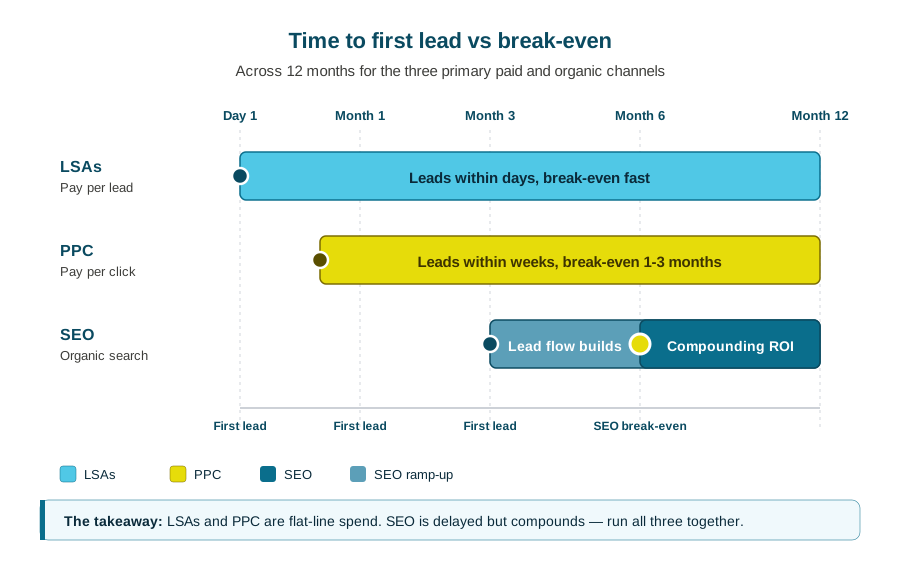
| Google Local Services Ads (LSAs) | $50–$200 | 10–20% | Small firms, fast results |
| Google Ads (PPC) | $300–$800+ | 3–10% | High-value cases, urgent needs |
| Legal Directories (Avvo, Martindale) | $20–$300 | 5–15% | Volume-based intake |
| Referrals & Reviews | Low/free | 30–50% | Trust-driven practice areas |
Strategy 1: Build a Law Firm SEO Engine That Compounds Over Time
If you only invest in one channel for client acquisition, make it search engine optimization.
Legal SEO is the highest-ROI lead source in the industry. Period.
According to SeoProfy’s Legal Marketing Statistics, law firms see an average 21% annual increase in website traffic from SEO. Visitor-to-lead conversion sits at 7.4%. The 3-year ROI averages 526%.
Compare that to PPC, where every click is a fresh expense.
SEO compounds. PPC drains.
A strong Search Engine Optimization foundation is what separates firms that compound growth year over year from firms stuck on the paid-ad treadmill.
Counterintuitive Truth: National SEO Is a Trap
Most law firms try to rank for broad terms like “personal injury lawyer.”
They lose every time.
The firms with seven-figure SEO budgets own those terms.
You won’t catch them, and even if you did, the leads you’d attract from generic national searches convert poorly.
The best-performing legal SEO campaigns are local-first, not national.
“Personal injury lawyer Mississauga” converts at 4–5x the rate of “personal injury lawyer.”
It ranks faster, costs less, and brings in clients who actually live in your service area.
What Modern Lawyer SEO Looks Like
The old playbook of keyword stuffing and link buying is dead.
Today’s winning law firms focus on:
Topical authority and practice-area clusters. Build deep content hubs around each practice area so Google sees you as the entity expert in that space.
Hyper-local intent mapping. Create dedicated landing pages for each city, neighborhood, and case type. Search intent in legal is overwhelmingly local.
Google Business Profile optimization. Verified address, weekly posts, photos, and a steady stream of reviews.
Generative Engine Optimization (GEO). AI-powered search (ChatGPT, Perplexity, Google AI Overviews) now drives a meaningful share of legal queries. Structuring content to be cited inside AI answers is one of the fastest-growing lead sources in attorney marketing today.
Schema markup. Attorney, FAQ, LocalBusiness, and Review schema so Google understands your site at the entity level.
Core Web Vitals. 47% of law firm websites fail Google’s recommended page load speed of 3 seconds. Speed alone can move rankings.
The Conversion Math Behind SEO
A well-optimized law firm website should convert 3–5% of visitors into leads. High-performing PPC landing pages can hit 10–15%.
If your current site converts below 2%, your conversion architecture needs work before you spend another dollar on traffic.
That’s a recurring theme in this guide: fix the leak before you turn up the tap.
For the technical foundation, our On-Page SEO Checklist walks through every element worth auditing on a law firm site.
Strategy 2: Run Google Local Services Ads for Predictable Lead Volume
Google Local Services Ads (LSAs) are the fastest entry point into legal lead generation today, especially for small and mid-sized firms.
Unlike PPC, LSAs charge per lead, not per click.
You only pay when someone actually contacts your firm.
They sit at the very top of Google search results, above standard ads, with a “Google Screened” badge that signals trust to high-intent searchers.
Why LSAs Work for Lawyers
- Pay-per-lead pricing, no wasted budget on tire-kickers.
- Top-of-page placement above paid and organic.
- Built-in trust signals through Google’s screening and license verification.
- Mobile-optimized for click-to-call, which makes up most legal searches.
According to LocaliQ’s Legal Search Advertising Benchmarks, the average CPL for legal search ads is $111. Personal injury hits $159. Bankruptcy comes in at $82.
Contrarian Insight: Most Firms Start PPC Too Early
Here’s a hard truth I share with most new clients: don’t run PPC until your intake process can convert leads at 30%+.
A $400 PPC lead that converts at 5% costs you $8,000 per signed case.
The same lead at 30% conversion costs you $1,333. Same ad spend. Six times the ROI.
Fix the intake first. Then turn on paid.
When LSAs Don’t Work
LSAs don’t reach corporate clients, general counsel, or B2B buyers. If your firm focuses on commercial litigation, IP, or employment law for businesses, skip LSAs entirely. Invest in LinkedIn, outbound prospecting, and thought leadership instead.
Strategy 3: Use Content Marketing to Build a Lead Engine That Doesn’t Sleep
Content marketing isn’t a standalone lead channel.
It’s the engine behind topical authority, entity SEO, and AI search visibility. Done right, a single well-researched piece can generate qualified leads for years at near-zero marginal cost.
The shift in legal marketing matters: Google now evaluates law firm sites at the entity level, not just the page level.
Firms publishing scattered, unrelated blog posts are losing ground to firms building tight, interconnected content clusters around specific practice areas.
Building Topical Authority and Practice-Area Clusters
Stop writing one-off posts. Structure your content as hubs.
Example: Personal Injury Practice Cluster
- Pillar page: “Personal Injury Law in [State] Complete Guide.”
- Cluster pages:
- “Average Settlement for Car Accidents in [City]”
- “How Long Does a PI Case Take in [State]”
- “What to Do After a Slip and Fall”
Example: Family Law Practice Cluster
- Pillar page: “Family Law Services in [City]”.
- Cluster pages:
- “Cost of Divorce in [State]”
- “Child Custody Laws Explained”
- “How to File for Spousal Support”
This structure does three things at once:
- Ranks better in traditional search.
- Gets cited more often in AI-generated answers.
- Builds genuine entity authority that compounds over time.
What Actually Works (and What Doesn’t)
| Content Type | Lead Quality | Effort | ROI Timeline |
| Practice-area pillar pages | High | High | 3–6 months |
| Local “cost of [legal service]” guides | High | Medium | 2–4 months |
| FAQ-style blog posts | Medium | Low | 3–6 months |
| Case study videos | High | High | Immediate–3 months |
| Generic legal news | Low | Low | Rarely converts |
HubSpot research shows businesses with active blogs get 55% more website traffic than those without. But traffic only matters if it converts.
The Modern Content Playbook for Lawyers
- Map content to local search intent. Every page answers a specific question a real client in your area is Googling.
- Use real data and citations. E-E-A-T signals reward credibility.
- Add a clear CTA. Free consultation, case evaluation form, and click-to-call.
- Update old content quarterly. Refreshed posts often beat new ones for ranking gains.
- Optimize for AI search. Structure answers in scannable, quotable formats so AI engines extract them cleanly.
If you’re new to mapping content to user intent, our breakdown on what local search intent really means is a good starting point.
Strategy 4: Turn Reviews and Referrals Into Your #1 Lead Source
Here’s the stat that should make every law firm pay attention:
Referrals and online reviews drive more new clients than any paid channel, and they convert at 30–50%, compared to 5–15% for paid leads.
Yet most firms put zero systems behind them.
The Modern Referral Stack
Referrals today don’t just come from past clients or other attorneys. They come from:
- Google reviews he #1 trust signal for local searches.
- Yelp, Avvo, and Lawyers.com ratings.
- Video testimonials on your site and YouTube.
- Professional referrals from accountants, financial advisors, and other lawyers.
- Community engagement, local sponsorships, chamber of commerce talks, and podcast appearances.
How to Systematize Reviews
Most firms ask for reviews at the wrong time, after a long, stressful case is over and the client just wants to move on.
The fix:
- Ask within 48 hours of a positive milestone (case won, settlement signed, friendly intake call).
- Send a direct Google review link via text, not email.
- Respond to every review, positive or negative, within 72 hours.
Strategy 5: Fix Your Attorney Intake Process: The Hidden Lead Killer
This is the strategy most law firms ignore.
It’s also where the biggest gains live.
According to AgentZap’s Law Firm Lead Generation Statistics, 35% of law firm inquiries, phone, and web combined, never receive any response. More than 1 in 3 leads you’re paying for go nowhere.
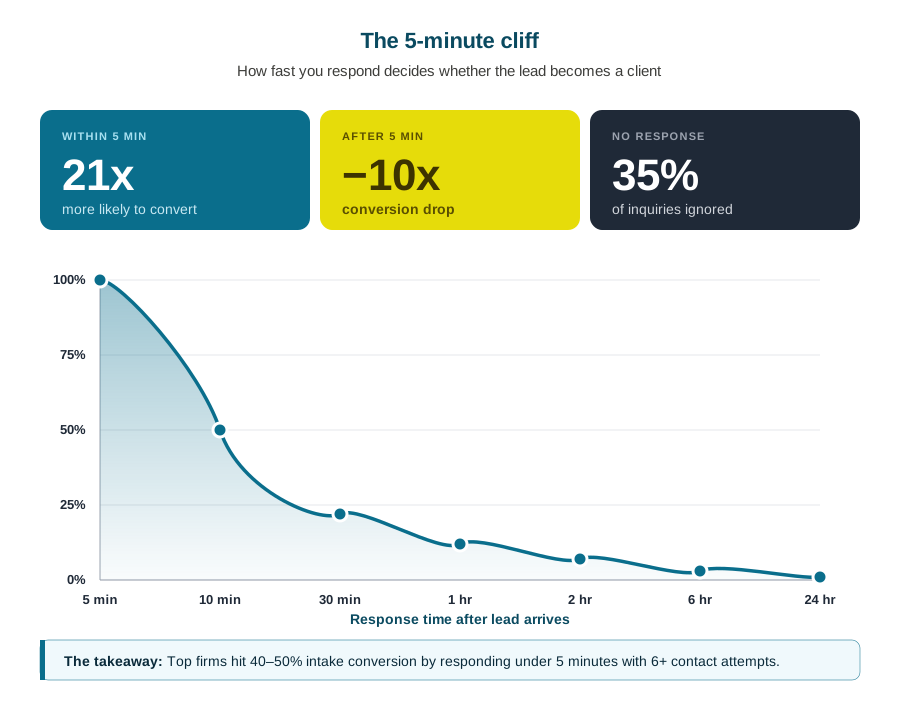
Even worse: contacting a lead within 5 minutes makes them 21x more likely to convert. After 5 minutes, your odds drop by 10x.
Read that again. More traffic rarely fixes a broken intake process.
The 5-Minute Rule
Top-performing firms hit a 40–50% intake-to-signed-client conversion rate.
Here’s what they do differently:
- Speed-to-contact under 5 minutes during business hours, with after-hours coverage.
- At least 6 contact attempts across phone, email, and text before giving up.
- Automated text confirmations and reminders for consultations (no-show rates drop from 30% to under 10%).
- Tracked metrics: ad spend, total leads, qualified leads, signed cases, CPL, and cost per signed case.
Tools That Make a Difference
Modern law firms layer intake automation with platforms like Clio Grow, MyCase, Lawmatics, or Smith.ai for 24/7 live answering.
The cost is far less than the leads being wasted right now.
Why Most Law Firm SEO Fails
Most legal SEO campaigns fail.
Not because SEO doesn’t work, but it works better in legal than almost any other industry.
They fail because firms make the same handful of avoidable mistakes.
After auditing dozens of law firm sites, here are the most common reasons campaigns underperform:
1. Generic, AI-padded content. Pages built to hit a word count, not answer a real question. Google’s helpful content updates have crushed this approach.
2. Weak local targeting. Trying to rank for “personal injury lawyer” instead of “personal injury lawyer [city].” National terms eat budgets and convert poorly.
3. No intake optimization. Driving traffic to a site that converts at 1.5% and has a 3-hour response time. Every dollar of SEO investment leaks out the bottom of the funnel.
4. Thin practice-area pages. A 400-word page covering “all our practice areas” instead of dedicated pillar pages with 1,500+ words per area, supported by cluster content.
5. Slow site speed. 47% of law firm sites fail Core Web Vitals. Speed is a confirmed ranking factor and a conversion factor.
6. No review acquisition system. Firms hoping clients leave reviews unprompted. They don’t. Reviews need to be asked for systematically.
7. Ignoring conversion architecture. No clear CTA, hidden phone number, no live chat, contact form buried three clicks deep. Traffic without conversion paths is wasted.
8. Skipping schema markup. No FAQ, Attorney, or LocalBusiness schema. Missing the structured data that helps Google (and AI search engines) understand the site.
Fix even three of these, and most law firms see meaningful lead growth within six months.
Mini Case Study: How a Mid-Size PI Firm Cut Cost Per Signed Case by 47%
Anonymized example from a recent engagement.
The Client: A 12-attorney personal injury firm in a mid-size U.S. metro market, generating roughly 80 leads per month from a mix of PPC and Avvo.
The Problem:
- Cost per lead averaging $312
- Lead-to-signed-case conversion stuck at 6%
- Cost per signed case: roughly $5,200
- Average response time to web inquiries: 3 hours 40 minutes
What We Changed:
| Lever | Before | After |
| Lead response time | 3h 40m | Under 5 minutes |
| Contact attempts per lead | 1.8 average | 6 minimum |
| SEO investment | $0 | $4,500/month for 6 months |
| Google Business Profile activity | Inactive | Weekly posts, review automation |
| Practice-area cluster pages | 4 thin pages | 22 interconnected pages |
The Result (after 6 months):
- Lead volume up 38% (organic share grew from 12% to 41%)
- Conversion rate climbed from 6% to 14%
- Cost per signed case dropped to $2,750, a 47% reduction
- Organic leads now drive the majority of new signed cases at near-zero marginal cost
The takeaway: more leads weren’t the answer. A faster intake process and a compounding SEO foundation moved the metric that actually matters, cost per signed case.
How to Choose the Right Strategy for Your Firm
Not every strategy fits every firm. Here’s a quick decision framework:
| If your firm is… | Start with… | Then add… |
| New or under $1M revenue | Local SEO + Google LSAs | Reviews automation |
| Mid-size, $1M–$5M | Content + SEO + PPC | Referral systems |
| Large or multi-location | Full-funnel SEO + LSAs + content | GEO, video, intake automation |
| B2B / Corporate focused | LinkedIn + outbound + thought leadership | Industry-specific SEO |
Frequently Asked Questions
What is lead generation for lawyers?
Lead generation for lawyers is the process of actively attracting potential clients who are looking for legal services and converting them into qualified inquiries.
It includes legal SEO services, Google Ads, LSAs, content marketing, legal directories, and referral systems combined with an attorney intake process that turns inquiries into signed clients.
How much does it cost to generate a lead for a law firm?
Costs vary widely by practice area and channel.
Average CPL for law firms ranges from $50 to $800+, with personal injury and mass tort at the top end and bankruptcy or family law at the lower end.
Cost per signed case, the metric that actually matters in client acquisition, ranges from $915 (SEO) to over $8,800 (high-competition PPC).
How much should a law firm spend on marketing?
Most established law firms spend 2–10% of gross revenue on marketing.
Newer firms or those in high-growth mode often spend 12–20%.
The right number depends on practice area, average case value, and cost per signed case targets.
Personal injury firms with high case values typically spend more in absolute dollars; bankruptcy and traffic ticket firms operating on thin margins spend less.
Is SEO better than Google Ads for lawyers?
For long-term ROI, yes, O is the higher-ROI channel for most law firms.
SEO leads cost roughly $183–$456 each, with a 3-year ROI of 526%.
Google Ads can deliver leads faster, but at a higher CPL and zero compounding value.
The smartest approach is to run both: paid for immediate cash flow, and SEO for long-term growth.
What is a good conversion rate for a law firm website?
A well-optimized law firm site should convert 3–5% of visitors into leads.
High-performing PPC landing pages can hit 10–15%. Below 2% means your conversion architecture (forms, CTAs, page speed, trust signals) needs work before you spend more on traffic.
How do lawyers generate leads online?
Lawyers generate leads online through five primary channels: search engine optimization (organic search), Google Local Services Ads, paid search (Google Ads), legal directories (Avvo, Martindale), and content marketing combined with reviews and referrals.
The highest-performing firms run an integrated mix and obsess over cost per signed case, not lead volume.
What’s the best lead generation strategy for a small law firm?
For most small firms, the best combination is Google LSAs (for fast lead flow) plus law firm SEO and content marketing (for long-term, low-cost client acquisition).
Add an attorney intake process with under-5-minute response times, and most small firms can compete with much larger competitors.
How long does law firm SEO take to generate leads?
Most law firms see meaningful organic traffic growth within 3–6 months and significant lead flow by 9–12 months.
The compounding nature of legal SEO means today’s work keeps generating leads for years, unlike paid lawyer advertising, which stops the moment your budget runs out.
Are pay-per-lead services like Avvo or Martindale worth it?
They can be, but only if your attorney intake process is fast and your conversion rate is strong.
Shared leads (sold to 3–5 firms) require 5-minute response times to win.
If your firm responds slowly or doesn’t track conversion, you’re better off investing in owned channels like SEO, content, and reviews.
What’s the difference between attorney marketing and law firm SEO?
Attorney marketing is the broad umbrella covering every channel a firm uses to generate clients, paid ads, content, branding, networking, and PR.
Law firm SEO is one specific (and high-ROI) discipline within that umbrella, focused on improving organic search visibility.
Final Word: Lead Generation Is a System, Not a Tactic
The law firms winning today aren’t picking one lead generation strategy. They’re building an integrated system:
- SEO for long-term authority
- LSAs for fast volume
- Content for trust
- Reviews for conversion
- Intake for efficiency
If you’re spending money on legal marketing without tracking cost per signed case, you’re flying blind.
Fix the metrics. Fix the intake. The right channels will pay for themselves many times over.
Most Law Firms Don’t Need More Leads
They need a system that converts existing traffic into signed cases.
Macro Digital helps law firms across North America improve SEO visibility, intake conversion, and local search performance so the cost per signed case goes down while case volume goes up.