When a homeowner in Mississauga spots a trail of ants marching across their kitchen counter at 9 PM, they’re not flipping through a directory.
They’re grabbing their phone, typing “pest control near me,” and calling whoever shows up first on Google.
That one search driven by clear local search intent and whether or not your business appears in the results can determine whether you win or lose a customer you’ll never even know you missed.
Canada’s pest control industry is in a strong growth phase.
According to IBISWorld, the market is currently generating $2.8 billion in revenue in 2026, with over 1,484 businesses operating across the country.
In cities like Toronto and Vancouver, bed bug infestations are surging, fuelling demand for specialized services.
And the businesses earning the most from this growth aren’t always the most skilled exterminators; they’re often the ones who’ve figured out SEO for pest control companies.
This guide breaks down exactly what that looks like, step by step.
Why SEO for Pest Control Companies Matters More Than Ever
You might be excellent at what you do.
You might have a flawless reputation and happy customers on every street in your city.
But if you’re not visible on Google, a significant portion of potential customers will never know you exist, and that has a direct impact on pest control business growth.
According to research cited by SEOmator, 98% of consumers search online for local businesses, and Google dominates that search traffic, which is why understanding the difference between SEO vs SEM is critical, as one builds long-term visibility, while the other delivers immediate but temporary results.
When someone searches “exterminator Toronto” or “rodent control Calgary,” Google shows a Local Pack, those three map-based business listings that appear at the very top of results.
Getting into that top three is one of the most valuable outcomes of pest control marketing.
The urgency factor makes this especially important for pest control.
BrightLocal’s research found that 88% of consumers who conduct a local smartphone search visit or call a business within 24 hours.
People dealing with a pest problem don’t spend weeks comparing options; they act fast.
If your pest control Google ranking in Canada puts you in front of them at that moment, you have a real chance of earning that job.
The other encouraging reality: many of your local competitors haven’t invested in local SEO for pest control yet, which means there’s still a genuine opportunity to build a meaningful lead before the market catches up.
The Canadian Pest Control Market Is Growing, And So Is the Need for Local SEO
Canada’s pest control sector has grown at a CAGR of 3.0% between 2020 and 2026 (IBISWorld, 2026).
The insect pest control segment alone is projected to nearly double from $1.32 billion in 2024 to $2.57 billion by 2035 (Market Research Future, 2026).
Climate change, urban density, and growing public health awareness are all fuelling demand.
More customers also mean more competitors.
The pest control companies investing in SEO for pest control companies in Canada today are building an advantage that compounds over time.
The ones waiting are simply making that gap harder to close.
Step 1: Optimize Your Google Business Profile for Local SEO Pest Control Rankings
If there’s one thing to prioritize after reading this, it’s this: fully optimize your Google Business Profile (GBP).
It is the most accessible and highest-impact tool available for local SEO for pest control, and it’s free.
Your GBP is your digital storefront on Google.
It appears in the Local Pack, on Google Maps, and in branded search results.
It’s often the first impression a potential customer gets of your business.
Complete Every Field to Strengthen Your Local SEO Pest Control Presence
Name, address, phone number, website, hours, and service areas: fill everything out completely.
Research shows that customers are 2.7 times more likely to trust a business with a complete Google Business Profile (SEOmator, 2026).
That trust is the bridge between a search and a phone call.
Choose the Right Categories to Boost Your Pest Control Google Ranking in Canada
Your primary category should be “Pest Control Service.” Add secondary categories that reflect what you actually do: “Exterminator,” “Wildlife Control Service,” or “Fumigation Service.”
Accurate categorization helps Google understand your services and improves your pest control Google ranking in Canada for the right searches.
Add Photos to Support Pest Control Marketing and Business Growth
Businesses with photos on their GBP receive 42% more direction requests and 35% more website click-throughs than those without (Google).
Upload photos of your team, vehicles, equipment, and job results. (Tastefully, of course, nobody needs to see a pile of dead cockroaches before their morning coffee.) This is free, five-minute pest control marketing that has a measurable impact.
Collect Reviews: The Currency of Local SEO for Pest Control
Google uses reviews as a local ranking signal, and customers use them to decide who to call.
After every completed job, send a short follow-up message asking for a Google review and include a direct link. Make it as easy as possible.
More importantly, respond to every review, including the negative ones.
A thoughtful response to a complaint shows professionalism to both future customers and Google’s algorithm, and it’s a small but consistent signal that helps your local SEO pest control rankings over time.
Step 2: Keyword Research: The Foundation of SEO for Pest Control Companies
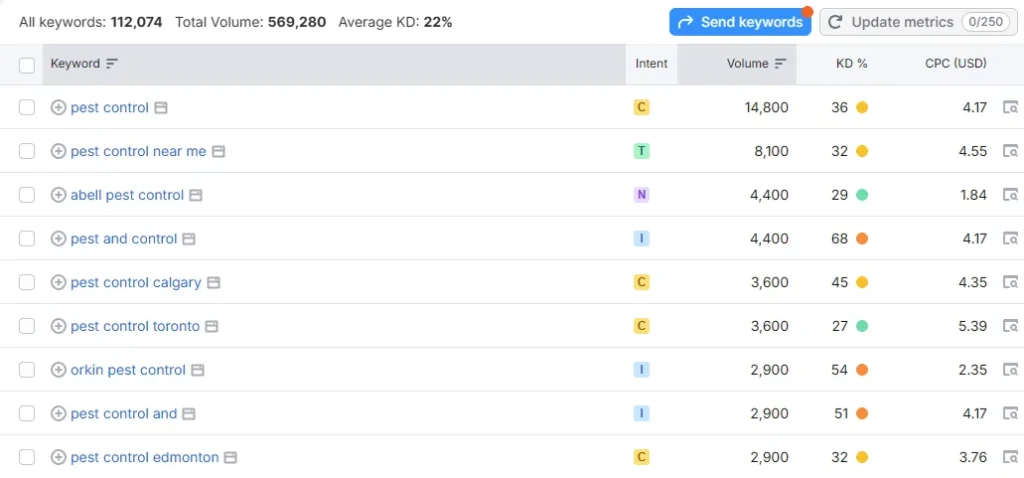
Keywords are the bridge between what your potential customers are typing into Google and what your website communicates back.
Getting this right is what makes SEO for pest control companies actually generate leads, not just traffic.
The Two Types of Keywords That Drive Pest Control Business Growth
Buying Intent Keywords searches from people who have a problem right now and want to hire someone today.
These are your highest-priority local SEO pest control targets:
- “bed bug exterminator Toronto”
- “rat removal Vancouver”
- “wasp nest removal Calgary”
- “cockroach control Mississauga”
- “emergency pest control near me”
Rank for these, and your phone rings.
Research Intent Keywords searches from people learning about a pest problem before deciding what to do.
These are better suited for blog content and support longer-term pest control business growth:
- “How to get rid of mice in my house”
- “Are bed bugs dangerous in Canada”
- “Signs of a termite infestation”
They bring in traffic early in the customer journey and keep your business in front of people before they’re ready to call.
Location-Based Keywords: Your Advantage in Pest Control Google Rankings in Canada
Generic terms like “pest control” are dominated by national chains.
Your edge is local. The most effective SEO for pest control companies targets specific city-plus-service combinations that large national brands can’t easily own at the neighbourhood level:
| Keyword Type | Canadian Example |
| City + Service | “pest control Edmonton” |
| Neighbourhood + Service | “pest control Scarborough” |
| Service + Near Me | “exterminator near me” |
| Emergency | “emergency pest control Ottawa” |
| Specific Pest + City | “bed bug treatment Winnipeg” |
| Eco-Friendly | “eco-friendly pest control BC” |
| Commercial | “commercial pest control Toronto” |
Build your service pages, blog content, and Google Business Profile around these combinations.
If you serve multiple cities, create a dedicated landing page for each location.
Seasonal Keywords: An Underused Driver of Local SEO for Pest Control
Pest activity in Canada follows predictable seasonal patterns, and publishing content ahead of each peak is one of the most underused pest control marketing strategies available.
Here’s a practical seasonal planning table:
| Pest | Peak Season | Target Keyword | Content Idea |
| Ants | Spring (March–May) | “ant control Ontario spring” | “Why Ants Invade Canadian Homes in Spring (And How to Stop Them)” |
| Wasps & Hornets | Late Summer (July–Sept) | “wasp nest removal Calgary” | “When to Call a Pro for Wasp Removal in Alberta” |
| Mice & Rats | Fall (Sept–Nov) | “rodent control Toronto fall” | “How to Mouse-Proof Your Home Before a Canadian Winter” |
| Bed Bugs | Year-round / post-holidays | “bed bug exterminator Vancouver” | “Bed Bug Prevention Tips After Holiday Travel in Canada” |
| Cockroaches | Winter (Dec–Feb) | “cockroach control indoor Canada” | “Why Cockroach Calls Spike in Canadian Winter (And What to Do)” |
| Mosquitoes | Summer (June–Aug) | “mosquito control Ontario” | “West Nile Risk in Ontario: What Homeowners Need to Know” |
Publish each piece of content 4–6 weeks before the seasonal peak.
Google rewards timely content, and your customers will find you exactly when they need you most.
Step 3: On-Page SEO: Making Your Website Work for Pest Control Marketing
Having a website isn’t enough. Every page needs to give Google the right signals to earn strong pest control Google rankings in Canada.
Optimize Title Tags to Improve Your Pest Control Google Ranking
Every page needs a unique title tag that includes your target keyword and location.
This is one of the most direct levers for pest control Google rankings:
- Instead of: “Home | Acme Pest Control”
- Use: “Pest Control Toronto | Acme Pest Control Licensed Exterminators”
Your meta description should be a compelling 150–160-character summary that includes the keyword and gives someone a clear reason to click.
Create Dedicated Service Pages to Power Pest Control Business Growth
Don’t cram all your services onto one page.
A core pillar of sustainable pest control business growth through SEO is building individual, fully-optimized pages for each major service:
- Rodent Control
- Bed Bug Treatment
- Cockroach Extermination
- Wasp & Hornet Removal
- Ant Control
- Wildlife Removal
Each page should target its own keyword-plus-location combination, include at least 800 words of practical content, and end with a clear call-to-action.
This architecture is what turns a basic website into a full-time lead generation system similar to proven lead generation strategies for franchise businesses that rely on location-based pages to scale growth.
Use Proper Heading Structure for Local SEO Pest Control Pages
Google reads your H1, H2, and H3 headings to understand what a page is about.
Your H1 should include your primary keyword.
Subheadings should naturally include location-based variations and secondary keywords.
This structure helps both Google and your visitors navigate the page, and it’s foundational to every local SEO for pest control page you build.
Mobile Speed Directly Affects Pest Control Google Rankings
Most pest control searches happen on smartphones, often in the middle of a stressful situation. If your website takes more than 3 seconds to load on mobile, many users will leave before reading anything.
Google also uses page speed as a direct ranking factor through its Core Web Vitals algorithm, which affects your pest control Google ranking across the board.
Quick wins: compress your images, use a reliable Canadian hosting provider, and add a caching plugin if you’re on WordPress.
Step 4: Canadian Trust Signals: What Local SEO for Pest Control Requires Beyond Rankings
This is a section that most generic SEO guides miss entirely, and it’s particularly important for pest control marketing, where licensing is mandatory, consumer trust is scrutinized, and the regulatory landscape varies by province.
Licensing and Certification: A Non-Negotiable Trust Signal
According to Canada’s Job Bank, a provincial pesticide applicator licence is required in all provinces before anyone can commercially apply pesticides.
For customers searching for a pest control company, seeing proof of valid licensing on your website is a meaningful trust signal, and it’s something your SEO should highlight clearly.
Each province has its own framework:
- Ontario: Governed by the Pesticides Act and O. Reg. 63/09, regulated by the Ministry of the Environment, Conservation and Parks (MECP). Pest control businesses must hold an Operator licence, and all technicians must carry individual Exterminator licences.
- British Columbia: Regulated under the Integrated Pest Management Act. Pesticide certificates from other Canadian provinces are generally not valid in B.C. without a reciprocity exam.
- Alberta: Each province runs its own certification program per the National Standard for Pesticide Education, Training and Certification.
What this means for your SEO: Display your licence numbers, certifications, and regulatory affiliations visibly on your website on your homepage, service pages, and footer.
This builds trust with both potential customers and Google’s quality assessment signals.
How to Feature Licensing in Your Pest Control Marketing
- Add a “Licensed & Certified” badge or section to your homepage
- List your provincial licence number and issuing body
- Include a line like: “All technicians hold valid [Province] Exterminator licences under [Act name]”
- Link to the provincial regulatory body so customers can verify independently
Eco-Friendly and Integrated Pest Management (IPM): A Growing SEO Opportunity
Canadian consumers are increasingly choosing greener options.
According to Grand View Research, consumers in Canada are increasingly favouring eco-friendly and sustainable pest control solutions, driving providers toward bio-based products and integrated pest management (IPM). Biological pest control methods are projected to grow at a CAGR of 7.2% through 2033 in Canada.
If your company offers IPM, low-toxicity treatments, or PMRA-approved bio-based products, these are significant differentiators worth building content around. Keywords like “eco-friendly pest control Ontario,” “green exterminator Vancouver,” or “low-chemical pest control Calgary” are still relatively low competition and growing in search volume.
Residential vs. Commercial Pest Control: Why They Require Different SEO Approaches
Residential and commercial pest control clients have different search behaviours, decision timelines, and trust requirements, and your pest control marketing should address both separately.
| Factor | Residential Clients | Commercial Clients |
| Search Behaviour | Urgent, mobile, “near me” searches | Research-driven, desktop, comparison searches |
| Decision Timeline | Same day or next day | Days to weeks |
| Key Trust Signals | Reviews, speed of response, licensing | Certifications, insurance, compliance records |
| Content Type | How-to blogs, seasonal tips, emergency guides | Case studies, compliance info, service contracts |
| Keywords | “bed bug exterminator near me” | “commercial pest control Toronto restaurant” |
Building separate landing pages and content streams for residential and commercial clients is one of the smartest structural moves in SEO for pest control companies.
Step 5: Local Citations: The Unglamorous Backbone of Local SEO for Pest Control
A local citation is any online mention of your business name, address, and phone number (NAP). Business directories like Yelp, HomeStars, and the BBB build a web of consistent signals that tell Google your business is real, established, and operating in a specific area, all of which support your local SEO pest control rankings.
The key is consistency. If your address appears differently across platforms, “123 Main St” on one and “123 Main Street” on another, Google’s algorithms register a mismatch, and your pest control Google ranking can suffer for it.
Where to List Your Pest Control Business
| Directory | Why It Matters for Pest Control Marketing in Canada |
| Google Business Profile | Essential for Local Pack and map rankings |
| HomeStars | Canada’s leading home services platform |
| Yelp Canada | High consumer trust, strong Google indexing |
| Better Business Bureau | Critical for commercial client trust |
| Yellow Pages Canada | Legacy platform still indexed by Google |
| Facebook Business | Social proof + searchability |
| Angi | Popular for home service discovery |
| Local Chamber of Commerce | High-quality local backlink + citation |
Aim for 20–30 consistent citations across reputable directories.
This is low-glamour work, but it’s one of the most reliable foundations of local rankings, just like Local SEO for franchises, where consistency across multiple locations directly impacts visibility.”
Step 6: Content Marketing: The Long-Term Engine of Pest Control Business Growth
Publishing regular, useful content is one of the highest long-term returns available in SEO for pest control companies.
It builds authority, captures research-intent traffic, and signals to Google that your website is an active, credible resource all of which compound into sustained pest control business growth.
Blog Topics That Support Local SEO for Pest Control and Drive Traffic
Answer the questions your customers are already searching for:
- “The 5 Most Common Pests in Ontario Homes (And How to Deal With Them)”
- “How Much Does Pest Control Cost in Canada in 2026?”
- “Are Bed Bugs Covered by Tenant Insurance in Canada?”
- “What to Expect During a Professional Rodent Inspection”
- “Eco-Friendly Pest Control Options in [Your City]: What’s Available”
Each post targets a real search query, drives targeted traffic, and builds the kind of topical authority that improves your overall pest control Google ranking, including for your service pages.
How Long Should Blog Posts Be for Pest Control Google Rankings?
For competitive pest control marketing topics, aim for 1,500–2,500 words per post. Longer, well-structured posts tend to outrank thin content.
That said, quality always wins over word count. A tightly-written 1,500-word post will outperform a padded 3,000-word one every time.
Add FAQ Sections for Local SEO Pest Control Visibility
FAQ sections are one of the smartest structural choices in local SEO for pest control content.
They target Google’s “People Also Ask” boxes, giving your content a second chance at visibility on the search results page even if you’re not ranking #1 organically.
Write each FAQ as a specific question (as the heading) followed by a clear, direct answer.
Step 7: Building Backlinks for Stronger SEO for Pest Control Companies
Backlinks, links from other websites pointing to yours, are among the strongest signals Google uses to assess the authority of your site.
More quality links mean a stronger pest control Google ranking, particularly for competitive terms in major cities.
How to Earn Local Backlinks That Fuel Pest Control Business Growth
Local business directories: consistent listing across Canadian directories is foundational to pest control marketing and doubles as link building.
Local news and community websites: offer to contribute a guest piece on seasonal pest prevention. Practical, useful content earns organic links.
Supplier and partner websites: if you use certified products or partner with property management companies, ask if they’ll add a link to your website.
Local Chamber of Commerce: Most Canadian chambers maintain member directories with live website links. This is one of the highest-quality local SEO pest control backlinks you can earn.
Community sponsorships: sponsor a local event, school fundraiser, or minor sports league and earn a link from the event website. Good for community reputation; good for pest control business growth through SEO.
Step 8: Tracking Results: Measuring Your Pest Control Marketing Success
SEO for pest control companies is an ongoing strategy, not a one-time project.
Rankings shift, competitors improve, and Google updates its algorithm regularly.
Tracking your performance lets you respond quickly and continue building on what works.
Tools to Track Your Pest Control Google Ranking
| Tool | What It Tracks | Cost |
| Google Search Console | Rankings, clicks, impressions, and indexing issues | Free |
| Google Analytics 4 | Website traffic, traffic sources, and lead conversions | Free |
| Google Business Profile Insights | GBP views, calls, and direction requests | Free |
| BrightLocal | Local rankings across multiple Canadian cities | Paid |
| Ahrefs / SEMrush | Keyword positions, backlinks, and competitor analysis | Paid |
For most local pest control businesses, the three free Google tools provide everything needed to start measuring the impact of pest control marketing.
Track your rankings monthly, identify which pages bring in the most traffic, and refine your approach accordingly.
How Long Does Local SEO for Pest Control Take to Show Results?
Local SEO for pest control can start producing measurable results in 30–90 days for less competitive search terms, especially in markets where local competitors haven’t yet invested in SEO.
For high-competition markets like Toronto, Vancouver, or Calgary, meaningful improvements in pest control Google rankings typically take 3–6 months of consistent effort.
The timeline varies. But the consistent finding is that starting earlier builds a stronger position over time.
Common Pest Control Marketing Mistakes That Hurt Your Google Rankings
A few patterns consistently hold pest control businesses back from the rankings their work deserves:
Ignoring mobile optimization: the majority of pest control searches happen on phones.
A slow or poorly formatted mobile website damages both user experience and pest control Google rankings in Canada.
Inconsistent NAP information: mismatched business details across directories create conflicting signals for Google. Audit every listing and make sure they all match exactly.
Not responding to reviews: silence, especially on negative reviews, reads as indifference to customers and signals inactivity to Google. Responding is one of the simplest free improvements available in local SEO for pest control.
Keyword stuffing: writing “pest control Toronto pest control service best pest control” into every paragraph will trigger a penalty, not a ranking. Write naturally, for people first.
Buying cheap backlinks: spammy link schemes can result in Google penalties that are difficult to recover from.
For sustainable pest control marketing, earn legitimate, relevant links.
Skipping seasonal content: if you’re not publishing content ahead of seasonal pest peaks, you’re consistently missing your highest-traffic windows.
The seasonal table in Step 2 is a practical starting point.
Frequently Asked Questions: SEO for Pest Control Companies
How much does SEO for pest control companies in Canada cost?
It varies based on market size and scope.
DIY local SEO for pest control costs your time primarily.
Hiring a professional agency typically ranges from $500 to $3,000+ per month.
The return depends heavily on execution quality and consistency.
A solid pest control Google ranking for a competitive term in a major city can generate significant organic lead volume over time.
Do I need a website for local SEO pest control marketing?
You can do basic local SEO for pest control through your Google Business Profile alone.
But to compete effectively and sustain long-term pest control business growth, a website is necessary.
It doesn’t need to be elaborate, but it does need to be fast, mobile-friendly, and properly structured.
What’s the difference between SEO and Google Ads for pest control marketing?
Google Ads deliver immediate visibility but stop working the moment your budget runs out.
SEO for pest control companies builds organic rankings that continue delivering traffic over time without ongoing ad spend.
Most competitive businesses use both Ads for immediate volume while SEO builds long-term pest control business growth.
How do I outrank national pest control chains?
Focus on hyper-local SEO for pest control.
National brands like Orkin and Rentokil carry broad authority at the national level, but they rarely dominate specific neighbourhood and mid-city searches.
Local expertise, local content, local reviews, and local backlinks are where your pest control marketing has a genuine structural advantage.
Is social media part of local SEO for pest control?
Social media doesn’t directly influence Google rankings, but it supports pest control marketing indirectly.
Sharing blog content drives website traffic, and a well-maintained Facebook Business page adds to your brand’s overall search footprint, both contributing incrementally to pest control business growth.
Wrapping Up: Building Sustainable SEO for Pest Control Companies
Canada’s pest control market is growing, competition is increasing, and more of the buying process is happening online.
The strategies in this guide, local SEO for pest control, Google Business Profile optimization, keyword research, seasonal content planning, Canadian trust signals like licensing and eco-credentials, citation building, and link earning, work best when applied consistently over time.
There are no guaranteed shortcuts to Google rankings.
But businesses that invest in these fundamentals steadily, publishing content, earning reviews, maintaining accurate listings, and building local authority, tend to build a visible, trusted presence that holds up well even through algorithm updates.
The best time to start was six months ago. The second best time is now.