
TL;DR The Quick Version
- The moving companies dominating Google in 2026 aren’t always the best movers. They’re the best marketers.
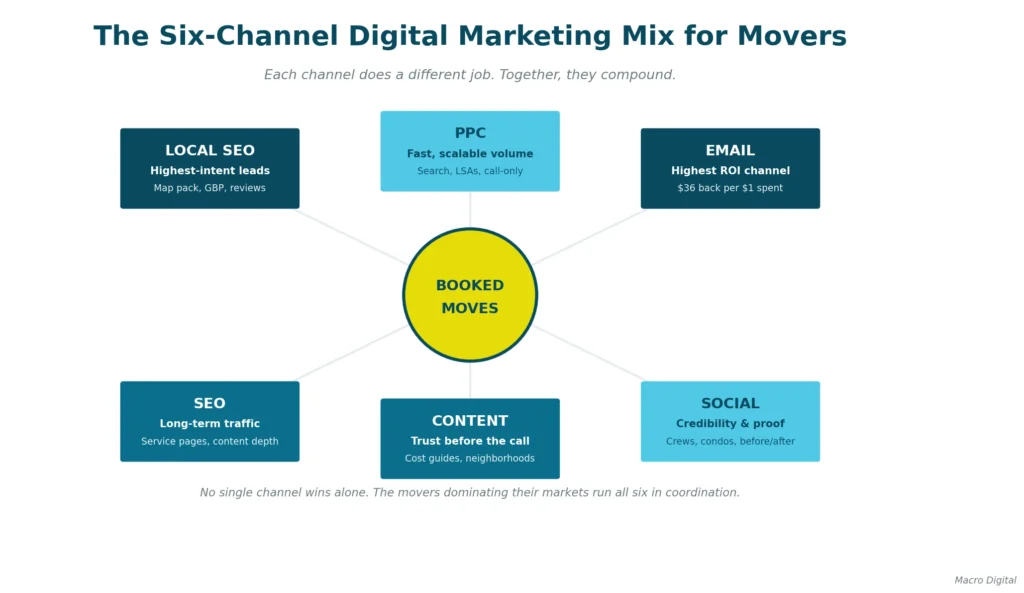
- A complete strategy combines six channels: SEO, local SEO, social media, content, PPC, and email, each one feeding the others.
- Local SEO is the single biggest lever. Showing up in the Google Map Pack puts you in front of customers with the highest buying intent and the lowest cost per lead.
- PPC delivers leads fast (moving-industry CPC runs roughly $6–$11, with summer bidding wars pushing it higher); SEO delivers leads cheaply over time. You want both.
- Email is the highest-ROI channel in marketing, with about $36 back for every $1 spent.
- Moving demand is seasonal, hyper-local, and emotionally charged. The strategies that win treat it that way.
Most moving companies don’t have a lead problem. They have a visibility problem.
The companies dominating Google in 2026 aren’t always the best movers.
They’re the best marketers. They show up first when someone searches “movers near me” at 11 p.m. on a Sunday. They have 400 recent five-star reviews.
Their quote forms load in two seconds on a phone. And they’ve figured out that moving is one of the most emotionally stressful purchases a person will ever make, so they market accordingly.
This guide breaks down the strategies that actually move the needle for movers: what works, what wastes budget, and how to combine the right channels for steady, profitable growth, whether you’re a single-truck operator or running multiple locations across North America.
Why Moving Is Different From Every Other Local Service
Before any tactic matters, you need to understand what makes moving unique as a marketing category. Get this right, and every channel below works harder.
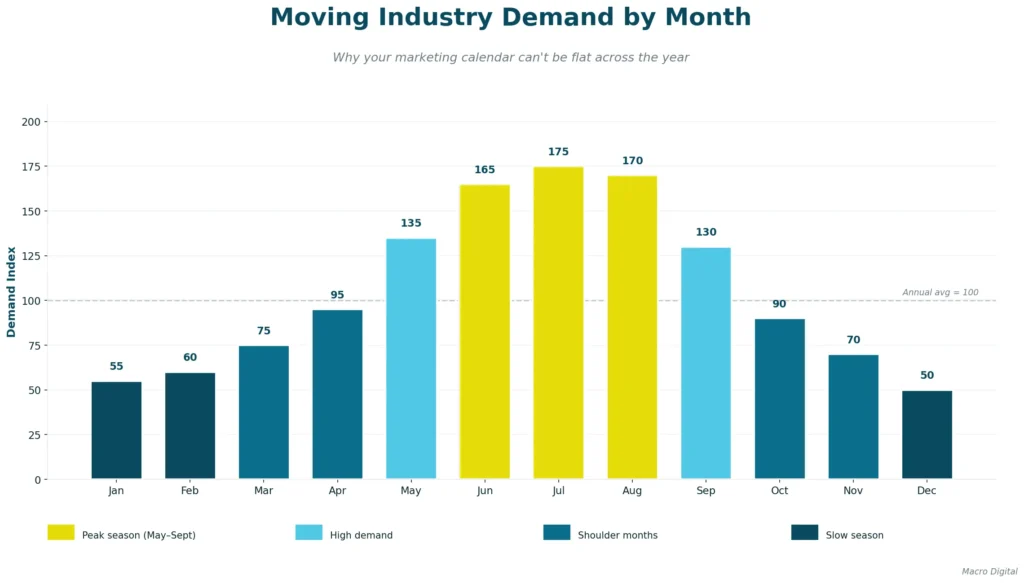
Moving is extremely seasonal
Demand spikes between May and September, with peaks at the end of each month when leases turn over.
December and January are graveyards.
Your marketing spend, ad budgets, and content calendar all need to reflect that curve.
Moving is emotional, not transactional
Customers aren’t shopping for the cheapest mover; they’re trying to protect their belongings, manage their stress, and avoid the horror stories they’ve read online.
The companies that win lean into reassurance: insurance, licensing, real photos of real crews, and recent reviews.
Moving has multiple sub-categories that behave differently:
- Local residential moves (high volume, low ticket)
- Long-distance moves (lower volume, much higher ticket, longer sales cycle)
- Commercial and office moves (B2B logic – relationships and referrals matter more than ads)
- Student moves (concentrated in August and April–May)
- Condo moves (logistics-heavy – elevator bookings, building rules, certificate of insurance)
- Last-minute and same-day moves (the highest-intent searches in the industry)
Each one needs its own keywords, its own landing page, and often its own ad campaign. Treating “moving” as one market is the most common and most expensive mistake movers make.
The buying window is short
Most people decide on a mover within 1–3 days of searching. That compresses your funnel and makes follow-up speed one of the highest-leverage things you can fix.
Keep these four realities in mind as you read everything below.
Why Moving Companies Can’t Ignore Digital Marketing
A decade ago, referrals and the Yellow Pages were enough.
Today, research happens online first. 97% of consumers read online reviews of a local business before visiting, and 99% of people have used the internet to look up information about a local business in the past year. If your business isn’t visible where customers are searching, you’re invisible to them altogether.
Online Visibility Equals New Leads
Most customers start with Google when they need a mover.
If your company doesn’t appear on page one and especially in the local map pack, your competitors will capture that business.
The intent behind these searches is high: around 2 in 10 local searches on a smartphone lead to a purchase within a day.
Trust Through Transparency
71% of shoppers begin their consumer research with Google reviews.
Movers are a “trust-first” purchase; people are letting strangers into their home and onto a truck with everything they own.
Recent, plentiful reviews aren’t a nice-to-have; they’re the gate.
The Mobile-First Customer
Most moving searches happen on a phone, often during the move itself (“movers Toronto open now,” “last-minute movers downtown”).
A mobile site that loads slowly, asks for too much information on the quote form, or hides the phone number behind a menu is leaking leads in real time.
Standing Out in a Crowded Market
In any major city, dozens of movers are bidding on the same keywords and chasing the same map pack positions. Digital marketing lets you stand out on the things that actually matter to customers: licensing, real crews, transparent pricing, condo expertise, specific service areas, instead of trying to out-shout everyone on “best movers.”
Cost-Effective Compared to Traditional Marketing
Flyers, billboards, and truck wraps build brand awareness, but they’re expensive and almost impossible to measure.
Digital marketing offers precise targeting, measurable ROI, and the flexibility to scale up before peak season and pull back when demand dies.
Shift in Consumer Behavior: How People Search for Movers Now
Today’s customer expects instant information, social proof, and convenience before making a decision.
For moving companies, your online presence has become your primary sales tool.
| Consumer Shift | What It Means for Movers |
| Search engines drive decisions | Customers type “best movers near me” instead of calling around. If you’re not optimized for local search, you’re not in the running. |
| Reviews are the new word-of-mouth | 72% of consumers say positive reviews make them trust a local business more. A handful of recent five-star reviews can outweigh a competitor’s older reputation. |
| Mobile search dominates | Most local moving searches happen on smartphones. A slow or clunky mobile site loses customers at the first click. |
| Instant gratification | Customers want instant quotes, same-day responses, and transparent pricing. If your form asks for 12 fields before they get a number, they’re gone. |
| Local preference | “Near me” searches keep climbing. Customers want a local mover that feels part of their community, not a national 1-800 number. |
| The two-day decision window | Most movers are chosen within 1–3 days of searching. Speed of follow-up and ease of booking often matter more than price. |
SEO for Moving Companies
SEO for moving companies is the most reliable long-term lead source for movers. Unlike paid ads that stop the moment you pause your budget, organic rankings compound, and the cost per lead drops every month they stay in place.
When someone searches “movers near me” or “best moving company in [your city],” the top three organic results plus the map pack capture the overwhelming majority of clicks.
On-Page SEO for Movers
Your site needs dedicated service pages for each sub-category: residential, long-distance, commercial, condo, student, packing, and storage.
Generic “we move everything” pages don’t rank for anything specific and convert poorly because they don’t address the prospect’s actual situation.
Each service page should:
- Use the target keyword naturally in the title, H1, URL, and first paragraph
- Include neighborhood and city names you actually serve
- Address the real concerns of that customer type (e.g., a condo moving page should mention elevator booking, certificate of insurance, building rules)
- Load in under three seconds on mobile
- Have a visible phone number and quote form above the fold
Off-Page SEO and Building Authority
Off-page SEO is about proving your company’s credibility across the wider web. Backlinks from real estate blogs, local news sites, community partner pages, and moving industry associations all tell Google you’re a real, trusted business.
For movers specifically, the highest-value backlinks tend to come from:
- Realtor and brokerage websites (partnerships are gold)
- Property management companies
- Local chambers of commerce and BBB
- Moving industry associations (CAM, AMSA)
- Local press coverage (community service, sponsorships)
Keyword Research and Strategy
Many movers chase broad terms like “moving company” with high search volume, but brutal competition and weak intent. The sharper plays are:
- Geo-modified service keywords “Toronto long-distance movers,” “Calgary office movers.”
- Sub-category keywords: “student movers,” “condo movers,” “piano movers,” “senior moving services.”
- High-intent modifiers: “same-day movers,” “last-minute movers,” “movers open Sunday.”
- Pricing keywords: “how much do movers cost in [city]” (rank-able with a real cost guide)
- Comparison keywords: “movers vs. U-Haul,” “[competitor] reviews.”
For multi-location operators, Franchise SEO ensures each branch ranks in its local market while strengthening the overall brand authority.
SEO as an Ongoing Investment
SEO isn’t a one-time project; it’s a continuous program. Search algorithms change, competitors publish new content, and your own pages need refreshing.
The movers who treat SEO as a monthly discipline rather than a one-time build are the ones who dominate after 12–18 months.
Local SEO Tactics: Dominating the Local Moving Market
For most moving companies, the overwhelming majority of jobs come from customers within a defined service radius.
That’s why local SEO for moving companies is the single highest-leverage channel for movers and the one where you’ll see the fastest, most dramatic results.
The intent behind local searches is exceptionally strong. 88% of consumers who conduct a local search on their smartphone visit or call a store within a day, and local searches lead to a purchase within a day for 18% of users, compared to just 7% for non-local searches.
If your business doesn’t appear in these results, you’re handing those leads to a competitor.
Google Business Profile Optimization
Your Google Business Profile (formerly Google My Business) is often the first impression customers get of your company, and it’s also the entry point to the map pack, which is the most valuable real estate on the page.
A fully optimized profile includes:
- Accurate name, address, and phone number (matching your website exactly)
- Service area definition (the cities and neighborhoods you actually serve)
- Primary category set to “Mover” and relevant secondary categories (“Moving and Storage Service,” “Piano Moving Service,” etc.)
- Real photos of trucks, crews, and completed moves (not stock images)
- Full description with service keywords
- Weekly posts (offers, tips, new services)
- Responses to every review, positive and negative
A Google Business Profile with accurate and complete information receives seven times more clicks.
Local Keywords and Neighborhood Pages
When customers search, they almost always include a location. “Movers in Etobicoke,” “long-distance movers Calgary,” “downtown Vancouver moving company.”
The movers who rank for these searches usually have dedicated location pages, not just one homepage that lists every city in a paragraph.
A strong neighborhood page includes:
- The neighborhood name in the URL, title, H1, and throughout the body
- Local landmarks, condo buildings, or university references
- Crew or truck photos with that neighborhood in the background, if possible
- Reviews from customers in that area
- A neighborhood-specific phone number or quote form
Consistency Across Directories (NAP)
Search engines reward consistency. Your name, address, and phone number must be identical across every directory: Yelp, Angi, HomeStars, Houzz, Yellow Pages, BBB, industry-specific moving directories, and your own website.
Even small discrepancies (“Street” vs. “St.”, “#202” vs. “Suite 202”) can suppress rankings.
The Power of Reviews
Local rankings are heavily influenced by review volume, recency, and rating.
A mover with 350 reviews averaging 4.8 stars, with the latest one from three days ago, will outrank a competitor with 80 older reviews almost every time, even if the competitor is closer to the searcher.
Tactics that work for movers specifically:
- Train crews to ask for the review in person at the end of a successful move (the highest conversion rate of any method)
- Follow up with an SMS containing a direct review link within 24 hours
- Never offer discounts or incentives for reviews that violate Google’s policy and can get listings suspended
- Respond to every review within 48 hours, even five-star ones
Recency matters: 32% of consumers only read reviews written within the previous 2 weeks.
Community Engagement and Local Links
Google rewards companies genuinely connected to their local area. Sponsoring a community event, partnering with realtors, donating moving services to local charities, or publishing local moving guides earns both visibility and the kind of authentic backlinks that move local rankings.
What Local SEO Looks Like When It Works
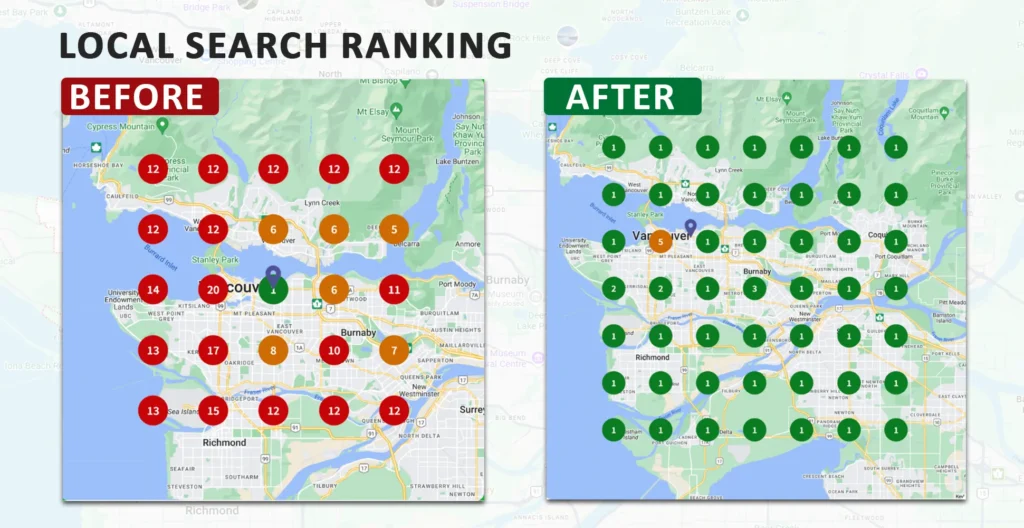
A local search grid is the clearest way to measure local visibility. It tracks where a business ranks for its core keyword across dozens of points throughout its service area. Green means a #1 ranking. Red means buried on page 2 or worse.
Here’s a real before-and-after grid from a North American moving company campaign:
- Before: the grid was almost entirely red areas of 11, 12, 13, and even 20 across the company’s core metro market. They ranked #1 in exactly one spot: right on top of their own location.
- After: the grid turned almost entirely green. The same business now ranks #1 across virtually its entire service area, with just one point still climbing.
That’s what a complete local SEO program looks like in practice, not one trick, but Google Business Profile optimization, neighborhood pages, consistent citations, ongoing review acquisition, and local content all compounding together over months.
Done right, local SEO doesn’t just put your company on the map; it keeps your phone ringing with high-intent leads ready to book.
PPC Advertising for Movers
PPC for movers gives instant visibility at the very top of Google.
Unlike SEO, which takes months to build, paid ads put you in front of customers who are searching right now, which makes PPC the fastest lever for filling capacity during peak season or stabilizing a slow month.
But moving is one of the most expensive and unforgiving PPC categories there is.
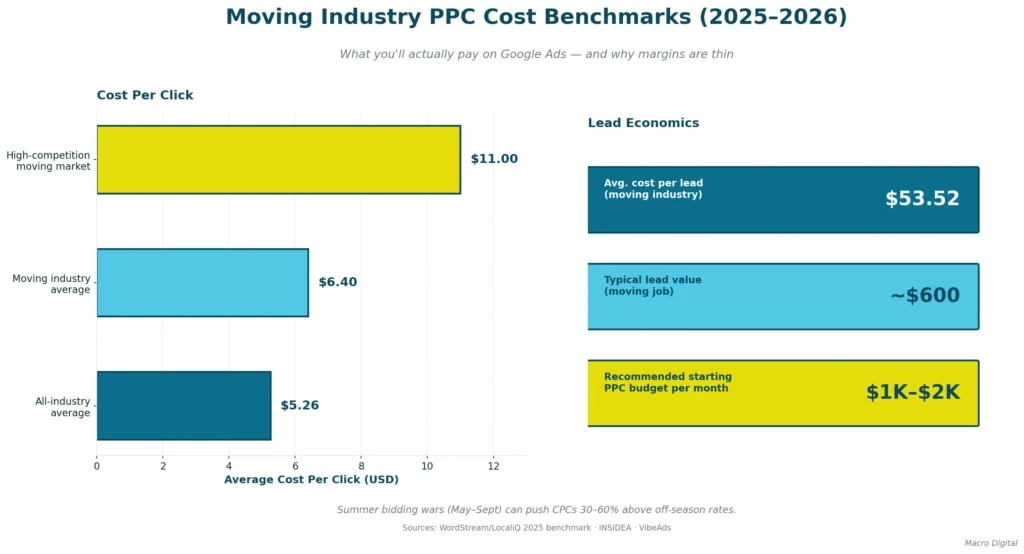
Across paid search overall, the average cost-per-click hit $5.26 in 2025, up 12.88% year over year, with 87% of industries seeing CPC increases.
For movers specifically, the average cost per click is approximately $6.40, with an average cost per lead of $53.52.
In high-competition markets, moving businesses can expect to pay around $11.00 per click, with typical lead values near $600.
Then the summer bidding wars hit. From May to September, every mover in your city pushes budgets up at once, and CPCs in major metros can climb 30–60% above off-season rates.
PPC results vary widely by market, season, and how well your funnel converts.
Be skeptical of any agency promising a fixed cost per lead.
The real numbers depend on your campaign structure, your landing pages, your call answer rate, and how fast you follow up.
A great campaign with a slow front desk still produces a bad ROI.
Campaign Types: Search, LSAs, and Call-Only
Most movers should start with three campaign types, in this order:
Local Services Ads (LSAs)
pay-per-lead, not pay-per-click. Appear at the very top of search above regular ads with the Google Guarantee badge.
Lower friction and often a better cost-per-lead than Search for movers, especially for residential local moves.
Search Campaigns
classic text ads. Most flexible, most control, best for capturing the full range of moving intent (long-distance, commercial, specialty).
Call-only Campaigns
mobile-only ads that trigger a phone call instead of a website visit.
Powerful for last-minute and same-day movers, where the customer just wants to talk to someone now.
Display, YouTube, and Performance Max can play supporting roles, but Search + LSAs + Call-Only is the operational core for most movers.
Match Types: Where Most Movers Burn Money
This is the single most common place where moving companies waste advertising budgets.
- Broad match: Broad Match shows your ad for anything it thinks is related. Without aggressive negative keywords, you’ll pay for clicks on “moving boxes,” “how to move a fridge yourself,” and “U-Haul rental.” Avoid as a default.
- Phrase match: Phrase is much tighter. Good middle ground for established campaigns with conversion data.
- Exact match: Exact Match, highest intent, highest control. Best for proven high-converting keywords like [movers Toronto], [long distance movers Vancouver], [last minute movers near me].
Most movers should start with exact and phrase match only, then test broad match selectively with strict negative keyword lists.
Negative Keywords: Your Most Important Asset
Negative keywords stop your ads from showing on irrelevant searches.
For movers, a baseline negative list should include:
- jobs, hiring, employment, salary, career
- DIY, free, cheap, yourself, how to
- boxes, supplies, tape, blanket (unless you sell supplies)
- U-Haul, PODS, Bekins (unless you want competitor traffic)
- truck rental, van rental
- piano tuning, moving sale, garage sale
A campaign without a robust negative keyword list will burn 20–40% of its budget on garbage clicks.
Review the search terms report weekly and add new negatives.
Geographic Radius Targeting
Movers serve specific areas, but Google’s default settings can serve your ads to people interested in your area, not just people in it.
That means clicks from people researching a move to your city from across the country, most of whom aren’t qualified leads.
Best practice for movers:
- Set location targeting to “Presence: People in or regularly in your targeted locations” (not “Presence or interest”)
- Use radius targeting around your warehouse for local move campaigns
- Layer in specific high-value neighborhoods, condo buildings, or university campuses as separate ad groups for the student season
Branded Search Defense
When someone searches your company name, competitors can bid on it and steal the click. Running a low-cost branded campaign bidding on your own company name defends that traffic, costs pennies per click because of a high quality score, and prevents lead theft. It’s one of the highest-ROI PPC moves a mover can make.
Conversion Tracking (Where Most Campaigns Are Lying to You)
If conversion tracking is broken, your data is fiction, and Google’s smart bidding will optimize toward the wrong thing.
The biggest tracking issues we see in moving company accounts:
- Form submissions tracked, but phone calls aren’t (movers get 50%+ of leads by phone)
- Calls tracked from ads but not from the website’s “click-to-call” button
- All conversions are counted as equal, even though a long-distance quote is worth 10× a residential quote
- Duplicate conversions from form + thank-you-page double-counting
Fix tracking before you scale spend. A campaign with bad data isn’t a campaign, it’s a guess with a credit card attached.
Landing Pages That Convert
Sending PPC traffic to your homepage is a costly mistake. Dedicated landing pages that match the ad copy convert far better.
A high-performing moving landing page should:
- Match the ad’s specific service (long-distance landing page for long-distance ads, condo page for condo ads)
- Show the phone number large and clickable at the top
- Offer a short quote form (4–5 fields max: name, phone, move-from, move-to, date)
- Display reviews, ratings, licensing, and insurance prominently
- Load in under 3 seconds on mobile
Landing pages matter enormously: in one analyzed campaign for a Toronto moving company, a high-converting landing page was a major factor in achieving a 21% conversion rate and a cost per lead of $46.50 even during a slow season.
Seasonal Bid Strategy
Moving demand is wildly seasonal, and your PPC strategy needs to reflect that:
- May–September (peak): budgets up, bids competitive, focus on capturing volume even at higher CPCs because lifetime value is highest when crews are fully booked
- End-of-month spikes: lease turnover concentrates demand, bidding up 3–5 days before month-end
- October–April (off-season): dial budget back, focus on long-distance and commercial campaigns that don’t follow the same curve, defend brand searches, build conversion data cheaply
Content Marketing for Movers
Content marketing is where movers escape the “everyone says the same thing” trap.
The competitors who win on Google have content libraries built around how customers actually think about moving, not generic blog posts about “10 packing tips.”
When done right, content marketing doesn’t just bring in visitors.
It turns them into qualified leads who already trust your brand before they ever pick up the phone.
Cost Content: The Highest-Converting Topic for Movers
Pricing transparency is the single most-searched topic in moving and the topic most competitors avoid.
Articles like:
- “How Much Do Movers Cost in [City] in 2026?”
- “Long-Distance Moving Costs: What to Budget for a 1,000-Mile Move.”
- “Condo Move Costs: Why It’s More Than a Regular Apartment Move”
…rank well, attract high-intent traffic, and pre-qualify leads. A prospect who’s read your cost guide and still calls is ready to book.
Neighborhood and City Guides
For movers, “moving to [city]” and “moving to [neighborhood]” guides are SEO gold.
They rank for the keyword, position your company as the local expert, and reach customers at the very start of the decision cycle before they even know they need a mover.
A guide to “Moving to Downtown Toronto” can include the best neighborhoods for families, condo move logistics, parking restrictions, school districts, and naturally introduce your services at the end.
Pain-Point Content
Moving is emotional. Content that acknowledges the anxiety and offers calm, practical solutions builds trust faster than any ad.
Topics like:
- “What to Do When Your Movers Are Late”
- “How to Move a Senior Parent Without the Stress”
- “Moving Day Anxiety: 7 Things That Actually Help”
- “Hidden Costs of Moving Nobody Warns You About”
These are the articles people read at 11 p.m. the night before a move.
They don’t get a lot of competing attention because most movers focus on “how to pack a box” content.
Realtor and Partner Content
Realtors are one of the highest-value referral sources for movers.
Content that serves them, like “10 Things to Tell Clients Before Move Day” or “Working With Movers: A Realtor’s Quick Guide,” builds the relationship while creating shareable assets that earn backlinks from real estate sites.
Visual and Interactive Content
Visual content punches above its weight for movers:
- Moving cost calculators: Interactive tools that capture leads and rank for cost-related keywords
- Move-day checklist: Downloadable PDFs that capture emails and rank for “moving checklist” searches
- Infographics: Packing timelines, what-to-purge-before-moving guides, room-by-room move plans
- Video walkthroughs: Short clips showing how your crew handles fragile items, condo moves, or piano relocations
Consistency Beats Brilliance
The most common content marketing mistake movers make is publishing five articles in a burst, then nothing for nine months.
A modest, consistent schedule of two posts a month, every month, outperforms sporadic bursts by a wide margin.
Search engines reward consistent publishing, and the cumulative library becomes a long-term asset.
For movers, content is more than marketing. It’s education, trust-building, and lead generation all in one.
Social Media Marketing for Movers
For movers, social media isn’t about virality; it’s about visibility, credibility, and the kind of social proof that turns a curious browser into a phone call.
The best moving social accounts feel like a window into a real business with real crews, real trucks, and real customers.
Choosing the Right Platforms
- Facebook: It is still the most effective platform for residential movers. Strong for community groups, neighborhood ads, and reviews, 40% of American consumers turn to Facebook to find business reviews.
- Instagram: It is best for showcasing crews, trucks, condo moves, and before/after content. Reels of full days condensed into 30 seconds perform extremely well.
- TikTok: It is surprisingly effective for movers. Short, raw content of crews loading trucks, packing fragile items, or navigating tight condo hallways gets shares because it’s genuinely interesting.
- LinkedIn: It is only relevant for commercial movers and companies pursuing corporate relocation contracts. Skip it for residential.
Moving-Specific Content That Works
The content that actually drives leads for movers:
- Truck and crew content: Humanizes the brand, builds trust before the customer ever calls
- Condo and tight-space moves: Prove you can handle the hardest jobs
- Before-and-after timelapses: Show full moves in 30 seconds
- Packing demonstrations: Of fragile items, electronics, art, and instruments
- Customer reaction videos: When permitted, a 10-second clip of a happy customer at the end of a move is more persuasive than any review
- Realtor and partner shoutouts: strengthen referral relationships publicly
Paid Social: Targeting That Actually Matches Moving Behavior
Facebook and Instagram ads are powerful for movers because the targeting matches how moving decisions actually happen:
- Lease-renewal renters: target renters in specific neighborhoods 60–90 days before peak lease turnover
- Recently engaged or married: life events that often trigger moves
- Lookalike audiences from past customers: feed Meta your customer email list, and let the algorithm find similar people
- Real estate page engages: people interacting with a realtor or home-buying content
- Off-season retargeting: keeps your brand in front of past website visitors so you’re top of mind when they finally need to move.
Measuring What Works
Track engagement, reach, and clicks, but the only metric that ultimately matters is booked moves. Tie your social performance back to actual revenue, not vanity metrics. A post with 50 likes that drove three quote requests is worth more than a viral video with 50,000 views and no calls.
Email Marketing for Movers
Email is the most underused channel in the moving industry.
Most movers collect a customer’s email at booking and then never email them again, leaving the highest-ROI marketing channel completely untapped.
On average, email drives an ROI of $36 for every dollar spent, higher than any other channel.
For movers, email pays off in three places: nurturing leads who haven’t booked yet, retaining past customers for repeat moves and referrals, and reactivating prospects who went quiet.
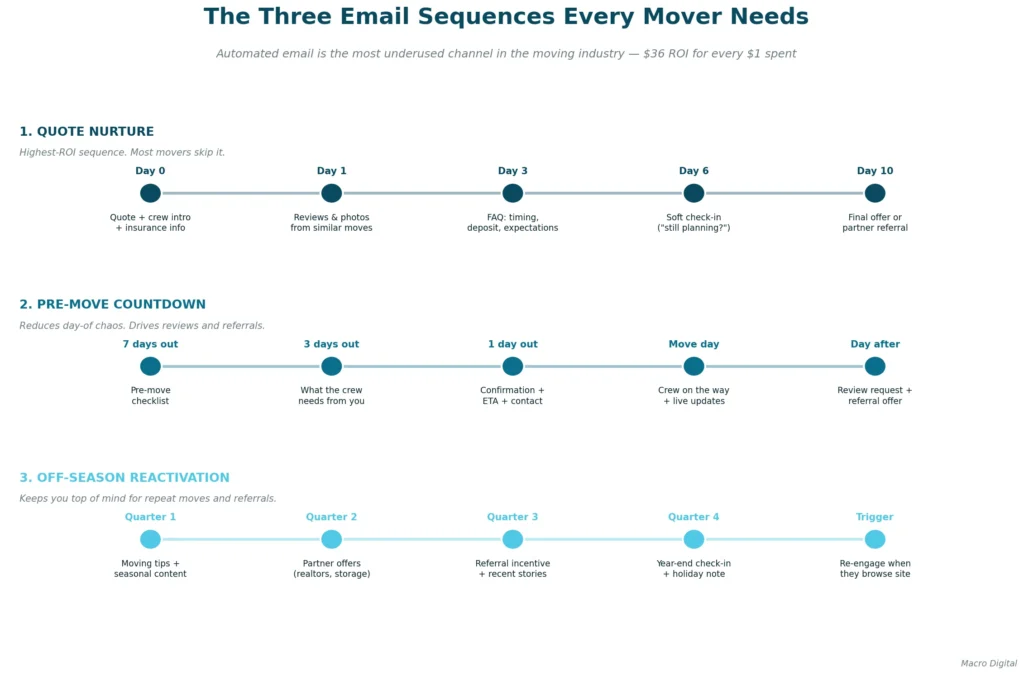
The Three Email Sequences Every Mover Needs
1. Quote nurture sequence (the highest-ROI play)
Most movers send a quote and then go silent. A 4–5 email sequence over 10 days dramatically increases booking rates:
- Day 0: Quote sent + crew introduction + insurance info
- Day 1: Reviews and photos from similar moves
- Day 3: Common questions (timing, deposit, what to expect)
- Day 6: Soft check-in (“still planning your move?”)
- Day 10: Final offer or referral to a partner if not booking
2. Pre-move sequence
For customers who booked, an automated countdown sequence reduces day-of chaos and improves the customer experience, which drives reviews and referrals.
- 7 days out: Pre-move checklist
- 3 days out: What the crew needs from you
- 1 day out: Confirmation, ETA, contact info
- Day after: Review request + referral offer
3. Off-season reactivation
Many residential customers move again within 2–5 years. A light quarterly newsletter to past customers, moving tips, partner offers, and seasonal content keep you top of mind and drive both repeat business and referrals.
Segmentation That Reflects Real Moving Behavior
Generic email blasts underperform. Movers should segment by:
- Move type: Local, long-distance, commercial, condo, student
- Status: Quoted but not booked, booked, completed, or past customer
- Location: Neighborhood-specific offers and partner promotions
- Time of year: Students get April/August sequences, families get summer sequences
Realtor and Partner Email Programs
A monthly email to your realtor and property manager partners, recent moves you’ve completed, capacity updates for the season, and partner perks for their clients keeps your name in front of the people who can send you a steady stream of referrals.
For more tactics, see our email marketing tips for moving companies.
Analytics & Tracking Success
One of the biggest advantages of digital marketing over traditional advertising is measurability.
Movers no longer have to guess which campaigns are working; analytics show exactly where leads come from and what each channel costs.
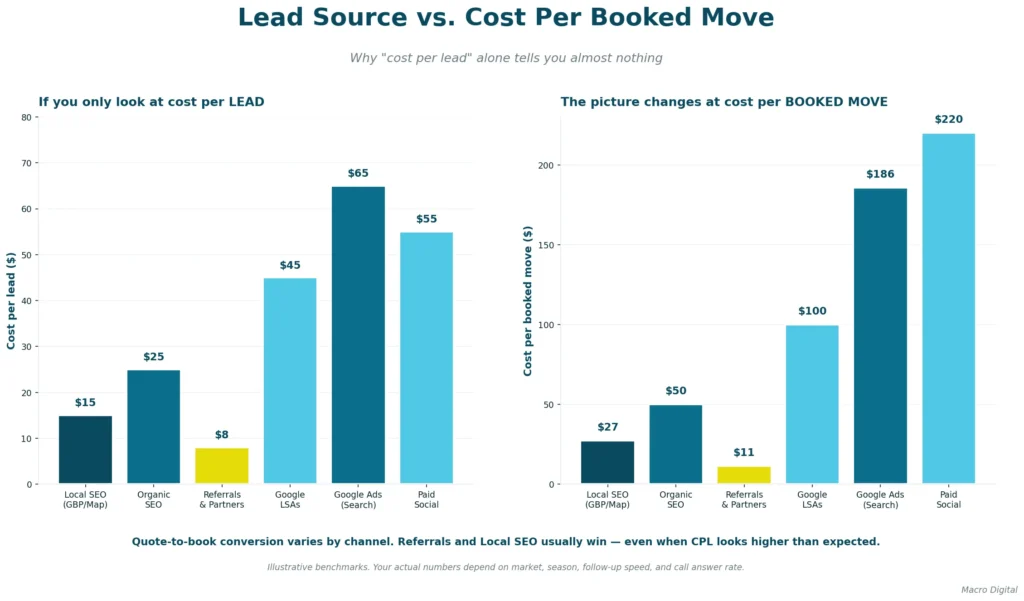
Key Metrics Every Moving Company Should Track
- Lead source attribution: For every booked move: Where did the lead come from? (PPC, organic, GBP, referral, social)
- Cost per lead by channel is usually wildly different between PPC, SEO, LSAs, and social
- Cost per booked move: The only number that ultimately matters
- Quote-to-book conversion rate: Exposes funnel and follow-up problems faster than anything else
- Call answer rate: The lead generation budget is wasted if calls go to voicemail
- Average revenue per move by source: Long-distance leads from one channel may be worth 10× residential leads from another
- Review volume and average rating: Are direct ranking signals and direct trust signals
The Tools That Matter
- Google Analytics 4: Traffic, conversions, channel attribution
- Google Search Console: Which keywords drive your organic traffic, and where you rank
- Call tracking software: (CallRail, CallTrackingMetrics is non-negotiable for movers, since 40–60% of leads come by phone
- Your CRM: Closes the loop between marketing and booked revenue
The Real Reason Movers Lose Leads
Most moving companies don’t have a lead generation problem.
They have a lead handling problem.
The most common revenue leaks we see in moving operations:
- Calls are going to voicemail during business hours
- Quote forms that take 24+ hours to receive a response
- Long, complicated quote forms that prospects abandon
- No follow-up sequence after the first quote
- No tracking on which crews, services, or campaigns produce the most profit
Fix lead handling before you scale ad spend. Doubling your lead flow into a leaky funnel just doubles the leak.
Conclusion
The moving industry in 2026 rewards the companies that treat marketing as seriously as they treat operations.
The trucks, the crews, the insurance, those table stakes simply get you ready to do the work.
The marketing decides whether you ever get the chance.
The strategies in this guide aren’t theoretical.
They’re the playbook for movers who want to dominate their local market: a complete local SEO program, a PPC operation that survives summer bidding wars, content that builds trust before the first call, and email and social media that turn one-time customers into a referral engine.
The future of moving is digital. The question is whether your company will be there when customers search.
Ready to Grow Your Moving Company Online?
Macro Digital helps moving companies turn search visibility into booked jobs. Get a free SEO audit, and we’ll show you exactly where your leads are leaking and what to fix first.
Frequently Asked Questions
What is the most effective digital marketing strategy for moving companies in 2026?
There’s no single channel that wins on its own; the most effective approach is multi-channel.
The movers dominating their markets in 2026 combine local SEO and Google Business Profile optimization (for the highest-intent leads), PPC and Local Services Ads (for fast, scalable volume during peak season), content marketing (to build trust and capture top-of-funnel searches), email (to nurture quoted leads and reactivate past customers), and social media (for credibility and community presence).
The channels feed each other: SEO reduces your dependence on PPC over time, content fuels both SEO and email, and reviews from happy customers strengthen everything.
How much should a moving company spend on digital marketing?
A common benchmark is 5–10% of annual revenue, but movers often need to flex that number with seasonality heavier in spring and summer, lighter in winter.
For PPC specifically, a starting budget of $1,000–$2,000 per month is recommended to generate steady leads in most local markets.
Larger or multi-location operators usually invest considerably more across SEO, PPC, social, and content.
The key metric isn’t how much you spend, it’s your cost per booked move, and how that compares to the lifetime value of that customer (repeat moves plus referrals). Goduo
How long does SEO take to generate leads for a moving company?
Most moving companies start seeing meaningful local SEO results in 3–6 months, improved Google Business Profile visibility, better map pack rankings in a few neighborhoods, and the first wave of organic leads.
Significant growth ranking in the top 3 for competitive terms like “movers near me” across an entire metro usually takes 6–12 months of consistent work.
The timeline shortens if you already have a strong domain, positive reviews, and a clean technical foundation.
Plan SEO as a 12-month minimum commitment, not a quarterly experiment.
What’s better for movers: SEO or PPC advertising?
Both. They solve different problems.
- PPC delivers leads fast, usually within a day, and lets you scale aggressively during peak season. Cost per lead is higher, but you can turn it on and off like a tap.
- SEO takes months to build, but drives a much lower cost per lead once rankings are in place. It’s compounding: every month your rankings hold, the ROI improves.
The movers who dominate their markets run PPC for short-term volume control and SEO for sustainable long-term growth.
How can moving companies get more Google reviews?
The single highest-converting tactic is the in-person ask at the end of a successful move.
Train crews to ask politely while the customer is still standing in their new home, happy that the move went well.
Back that up with an SMS containing a direct review link within 24 hours.
Never offer discounts or incentives for reviews that violate Google’s policy and can get your listing suspended.
Consistency matters more than volume: a steady stream of recent reviews improves both local rankings and customer trust, especially since many consumers only trust reviews from the last couple of weeks.
How do moving companies compete with big national brands online?
Local movers have advantages national brands can’t replicate: genuine community presence, faster response times, neighborhood-specific expertise, and authentic local reviews.
The path to outranking national competitors in local search is to lean into those advantages: neighborhood pages, real photos of local crews, partnerships with local realtors, sponsorships of community events, and a steady flow of recent reviews from local customers.
Targeted PPC at the neighborhood or zip-code level further closes the gap.
Customers usually prefer a trusted local mover over a faceless national brand, as long as you show up where they’re searching.